

Get Response within 60 Seconds.
Share a few details and get an instant response — one of our setup advisors will follow up with your personalized breakdown right away
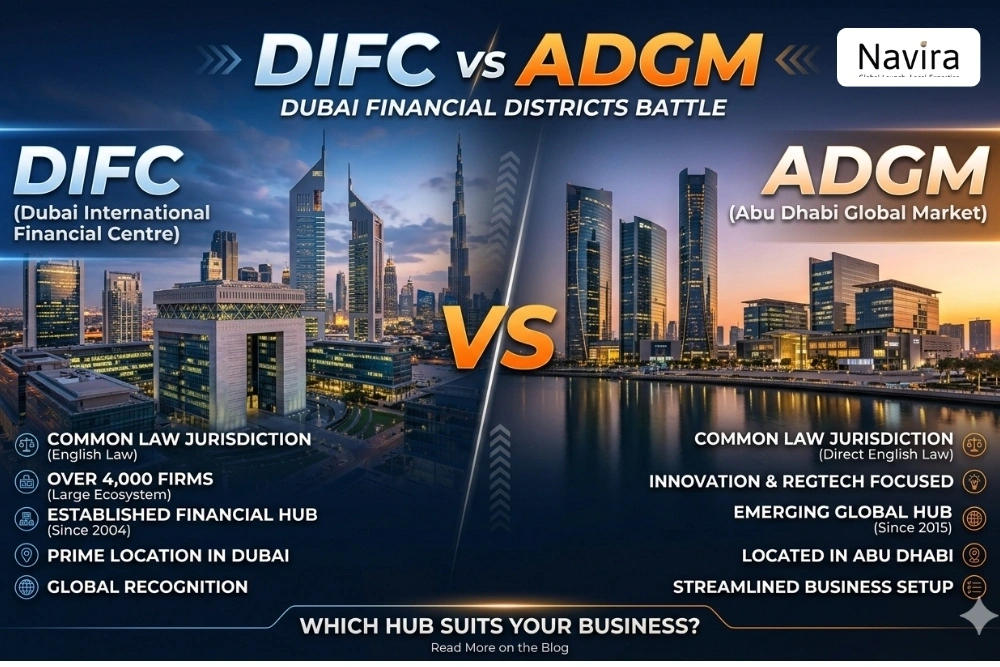
DIFC and ADGM at a Glance
The UAE is home to two of the world’s most respected onshore financial centres — and while they share a common geography and a broadly similar regulatory philosophy, the differences between them matter enormously for business strategy, cost efficiency, and legal structuring.
| DIFC — Established 2004 : Dubai’s financial district, regulated by the DFSA8,844 active companies · Full Year 2025 (↑28% YoY)50,200+ professionals employedCodified common law system102 hedge funds and 500+ wealth firmsDubai ranked 7th in GFCI 2026 (up from 11th)AED 100Bn ($27Bn) Za’abeel expansion underwayQ1 2026: 775 new companies (+62% YoY) | ADGM — Established 2015 : Abu Dhabi’s financial centre, regulated by the FSRA12,671 active licenses · Full Year 2025 (↑30%)3,495 operational entities (↑~40% YoY)44,339 workforce (↑51% YoY)Direct English common law applicationAbu Dhabi ranked #1 MENA, 12th globally (NYU Stern FCCI)347 financial institutions; AUM ↑36% in 2025Binance: first global crypto license from FSRA (Dec 2025) |
| KEY INSIGHTThe choice is rarely about which free zone is ‘better’ in absolute terms — it’s about alignment. DIFC suits businesses seeking maximum ecosystem depth and private client access. ADGM suits those prioritising structural flexibility, sovereign proximity, and English law alignment. |
// Section 02
Head-to-Head Comparison Table
| Factor | DIFC (Dubai) | ADGM (Abu Dhabi) |
|---|---|---|
| Established | 2004 (20+ years) | 2015 (10 years, full-year 2025 milestone) |
| Location | Dubai, Sheikh Zayed Road | Al Maryah Island, Abu Dhabi |
| Legal System | Codified common law (DIFC Law) | English common law (direct application) |
| Regulator | DFSA | FSRA |
| Court System | DIFC Courts (international judges) | ADGM Courts (international judges) |
| Active Entities | 8,844 active companies (FY 2025, ↑28%) | 12,671 active licenses (FY 2025, ↑30%) |
| Workforce | 50,200 professionals | 44,339 individuals (↑51% YoY) |
| Corporate Tax | 0% for qualifying activities (QFZP) | 0% for qualifying activities (QFZP) |
| Foreign Ownership | 100% | 100% |
| SPV Regime | Available (standard structures) | Most flexible in region (RSC) |
| Foundation Structures | 1,115 foundations (↑66% YoY, 2025) | Foundations + MD 261 CT-neutrality |
| Digital Assets | DFSA virtual asset framework | FSRA + Binance global license (Dec 2025) |
| Regulatory Fees | USD 10,000–70,000 (category-based) | USD 5,000–30,000/activity (activity-based) |
| Registration Fees | ~USD 20,000/yr | USD 5,500 non-fin. / ~USD 15,000 regulated |
| GFCI / FCCI Rank | Dubai: 7th globally (GFCI 2026) | Abu Dhabi: #1 MENA, 12th globally (NYU Stern 2025) |
| Best For | Banking, wealth mgmt, hedge funds, IPOs | PE, holding cos, SPVs, sovereign-adjacent, digital assets |
// Section 03
Legal Framework and Court Systems
Both jurisdictions operate under common law systems, entirely separate from the UAE’s civil law framework. This gives international businesses the legal certainty and predictability they expect from jurisdictions like England & Wales or Singapore. But the two centres differ in a subtle yet commercially important way.
DIFC: Codified Common Law
DIFC operates under its own codified body of laws — the DIFC Laws and Regulations — modelled on English common law but distinct from it. English court judgments are persuasive, not binding. Over two decades, DIFC Courts have built a substantial body of their own case law, making them a mature, well-regarded system. The Dubai International Arbitration Centre (DIAC), co-located within DIFC, provides globally recognised arbitration services.
ADGM: Direct Application of English Law
ADGM directly applies English law in most circumstances, meaning English court precedents are highly persuasive and often binding — making ADGM structurally very close to an English jurisdiction. For UK-headquartered financial institutions or funds with LPA documentation under English precedent, this alignment significantly reduces legal adaptation costs and documentation risk.
| PRACTITIONER TIP : If your fund constitutional documents, LPA templates, or master agreements are drafted under English law, ADGM offers a natural legal home with far less redrafting required. For bespoke regional structures and new precedent-setting arrangements, DIFC’s developed case law may be more useful. |
// Section 04
Regulatory Bodies: DFSA vs FSRA
| DFSA (DIFC) : Regulates all financial services within or from DIFC. Five activity categories; capital requirements and supervision scaled accordingly.DIFC hosts 1,052 regulated financial firms, including 290+ banks/capital markets institutions and 102 hedge funds.In 2025, DFSA financial services authorisations grew 21% YoY in Q1 2026, reflecting sustained institutional demand.Known for thorough — sometimes lengthy — review processes, which contributes to strong international regulatory credibility. | FSRA (ADGM) : Activity-based licensing: firms pay per regulated activity, creating granular flexibility. More innovation-forward posture.In December 2025, the FSRA issued Binance the world’s first formal global crypto exchange license — a landmark for compliant digital asset ecosystems.FSRA issued 120 In-Principle Approvals in 2025 (↑32% YoY) and 94 new Financial Services Permissions.FSRA RegLab sandbox remains one of the region’s most active environments for fintech and digital asset testing. |
| KEY DIFFERENCE : DFSA fees are category-based (one fee covering your highest activity category). FSRA fees are activity-based (separate fee per regulated activity). For single-activity firms, ADGM is cheaper. For diversified financial firms, costs can converge — model your specific activity mix before comparing. |
// Section 05
Cost Breakdown: Setup and Annual Fees (2026 Schedule)
Cost is one of the most searched dimensions of this comparison — and also one of the most frequently oversimplified. The right answer depends heavily on your activity mix, office footprint, and entity type.
| DIFC — Indicative Costs : DFSA Regulatory Fee: USD 10,000–70,000DIFC Registration Fee: ~USD 20,000/yrOffice Space (Grade A): From USD 80/sq.ftTechnology Licence: USD 1,500/yr (yr 1–2)Innovation Licence Workspace: USD 500/monthTypical total (Fund Manager): USD 40,000–100,000+ | ADGM — Indicative Costs (2026 Fee Schedule) : FSRA Fee (per activity): USD 5,000–30,000Non-financial company registration: USD 5,500 (new 2025 schedule)Non-financial annual renewal: USD 5,000Office Space (Grade A): From USD 80/sq.ftSPV Annual Maintenance: USD 2,000–5,000Typical total (Fund Manager): USD 25,000–70,000 |
| IMPORTANT NOTEThese are indicative ranges only. The ADGM 2025 Revised Fee Schedule (effective 2026) has been updated. All Al Reem Island transitional fee waivers have expired. Always verify current schedules directly with DFSA and FSRA. Late corporate tax registration under UAE CT now attracts AED 10,000 penalty; late tax payments carry a 14% flat annualised penalty rate effective April 2026. |
Bottom line on costs: ADGM is generally more cost-effective for startups, single-activity businesses, and holding structures. DIFC may offer better value for large, multi-activity financial institutions. For SPVs and pure holding entities, ADGM’s regime is significantly cheaper to maintain.
// Section 06
Holding Companies: Which Is Better — DIFC or ADGM?
This is one of the highest-value decisions for family offices, private equity houses, and investment groups structuring their UAE presence. Both jurisdictions support holding company structures, but ADGM has established meaningful structural advantages.
Why ADGM Leads for Holding Structures
ADGM’s Special Purpose Vehicle (SPV) regime is widely regarded as the most flexible in the region. The Restricted Scope Company (RSC) allows sponsors to operate with enhanced confidentiality and adaptability — particularly useful for co-investment vehicles and bespoke family office structures.
The landmark Ministerial Decision 261 (2024) dramatically enhanced ADGM’s attractiveness for wealth structuring. Under MD 261, ADGM Foundations can hold SPVs and Companies without triggering UAE Corporate Tax. By end-2025, ADGM hosted operational entities including foundations within a significantly expanded ecosystem across Al Maryah and Al Reem Islands. Major global names including KKR, Partners Group, UBS, and Julius Baer set up in ADGM during 2025.
When DIFC Makes Sense for Holding Structures
DIFC remains compelling for holding companies that need direct connectivity to private banking and wealth management networks. By end-2025, DIFC was home to 1,289 family-related entities (↑61% YoY) and 1,115 DIFC-based families had established foundations (↑66% YoY). In Q1 2026, foundation registrations rose a further 108% year-on-year, to 158 new foundations in a single quarter.
| HOLDING COMPANY VERDICT (2026)For pure holding and wealth structuring with tax efficiency, ADGM holds a structural edge — particularly post-Ministerial Decision 261. For holding companies with active investment management platforms or families seeking proximity to DIFC’s deep financial ecosystem, both deserve detailed analysis. DIFC’s foundation momentum in Q1 2026 (+108% YoY) shows it is rapidly closing the gap. |
// Section 07
Fund Setup: DIFC vs ADGM
Fund managers choosing between DIFC and ADGM need to align their decision with three key variables: investor base and location, asset class and strategy, and target emirate and ecosystem partnerships.
| Fund Type | DIFC Advantage | ADGM Advantage |
|---|---|---|
| Hedge Funds | 102 hedge funds; 37% sector growth 2025; prime brokerage links | Suitable; English law for UK-based managers |
| Private Equity | Strong ecosystem; established LP networks | PREFERRED: Flexible RSC; sovereign proximity; KKR, HarbourVest, Adams Street joined 2025 |
| Co-Investment | Standard structures available | PREFERRED: RSC confidentiality and adaptability |
| Wealth / Family Office | PREFERRED: 500+ wealth firms; 1,289 family entities; deep private client networks | Growing; Foundation + SPV tax neutrality (MD 261) |
| Digital Asset Funds | DFSA virtual asset framework; Dubai AI Campus ecosystem | OFTEN PREFERRED: Binance global license (Dec 2025); FSRA innovation posture |
| Real Estate Funds | PREFERRED: DIFC PropTech Hub; Dubai real estate depth (AED 917Bn transactions 2025) | Growing; ADX $800Bn+ market cap; green bonds |
| Sovereign / Institutional | Suitable; global institutional relationships | PREFERRED: Proximity to ADIA, Mubadala, ADQ |
| FUND SETUP VERDICTThere is no universal answer. If you prize a long-established financial centre with deep private client networks, DIFC is compelling. If you value English law alignment, flexibility for private market structures, digital asset regulatory leadership (Binance license), or a fast-moving innovation agenda, ADGM will often be the better fit. |
// Section 08
Tax Advantages and Corporate Tax (2026 Update)
The UAE federal Corporate Tax (CT) of 9% has been effective since June 2023. Both DIFC and ADGM have structured their operating rules to ensure qualifying financial services entities can continue to benefit from 0% effective tax rates on qualifying income — but the detail matters.
UAE Corporate Tax — Key Points for Both Zones
Qualifying Free Zone Persons (QFZPs) may benefit from a 0% rate on qualifying income, provided they meet conditions including: maintaining adequate economic substance, not earning excluded income from mainland UAE activities, and meeting the de minimis threshold. Income from non-qualifying activities is taxed at 9%.
For 2026 enforcement focus: late CT registration now attracts a fixed AED 10,000 penalty. Late payments carry a 14% flat annualised penalty rate (effective April 2026). Maintaining QFZP status requires documented adequate economic substance.
ADGM’s Structural Edge: Ministerial Decision 261
Ministerial Decision 261 (2024) allows ADGM Foundations to hold SPVs and subsidiaries without creating CT crystallisation events. This is a material benefit for family offices using Foundation → SPV → operating asset chains — a common intergenerational wealth transfer structure. ADGM’s Administrative Regulations 2025-2026 also enhance enforcement powers, with penalties up to USD 54 million for serious regulatory breaches.
No Personal Income Tax in Both
Neither DIFC nor ADGM impose personal income tax on employees or investors. There is no withholding tax on dividends, interest, or royalties. Capital gains tax does not apply in either jurisdiction, though disposal gains may be subject to UAE CT depending on entity structure.
| TAX PLANNING TIPThe interplay between UAE Corporate Tax, free zone status, and international treaties is complex and evolving. Always engage a UAE-qualified tax adviser before finalising structuring decisions. The guidance above is informational only. |
// Section 09
Ecosystem, Talent, and Market Access
DIFC: The Established Global Financial Hub
DIFC’s ecosystem is the most developed in the MEASA region. By end-2025, DIFC hosted 8,844 active companies — including Goldman Sachs, PIMCO, Warburg Pincus, Cambridge Associates, Manulife, and others who joined in 2025. The centre hosts over 290 banks and capital markets institutions, 135 insurance and reinsurance firms, and more than 500 wealth and asset management firms.
The DIFC FinTech Hive is the region’s largest fintech accelerator. The Dubai AI Campus grew 35% to 1,677 AI and fintech companies in 2025, fully integrated into the DIFC ecosystem. Start-ups supported by DIFC’s innovation platforms have raised more than USD 4.5 billion regionally. In Q1 2026, DIFC recorded a 62% rise in new company registrations year-on-year — the strongest quarterly intake on record.
The announced AED 100 billion ($27 billion) Za’abeel District expansion — targeting 42,000 companies and 125,000 professionals across 17.7 million sq.ft — signals DIFC’s ambition to cement its position through 2040. Dubai also hosted the Global Privacy Assembly in 2026, reflecting DIFC’s role at the forefront of data protection regulation.
ADGM: The Fast-Growing Sovereign-Adjacent Hub
ADGM’s 10th anniversary year, 2025, was its most transformative. Active licenses surpassed 12,000. Its workforce grew 51% to 44,339 individuals across Al Maryah and Al Reem Islands. AUM rose 36%, with 171 asset and fund managers overseeing 244 funds. Financial institutions grew to 347, with global names including KKR, Partners Group, UBS, Julius Baer, HarbourVest, and Davidson Kempner joining in 2025.
Abu Dhabi was ranked the #1 financial centre in the MENA region and 12th globally in the inaugural Financial Centre Competitiveness Index (FCCI) published by NYU Stern School of Business. The emirate also hosted the International Forum of Sovereign Wealth Funds (IFSWF) in November 2025. ADGM’s jurisdiction expanded to Al Reem Island in 2025, launching 70+ digital real estate services. A Mubadala-Aldar joint venture valued at over Dh60 billion was announced to further develop Al Maryah Island.
In December 2025, Binance secured the world’s first formal global crypto exchange license from the FSRA — cementing ADGM’s position as the UAE’s digital asset regulatory leader.
// Section 10
Decision Framework: Which One Is Right for You?
There is no objectively superior choice. Your optimal jurisdiction depends on a clear-eyed assessment of your business model, investor base, asset class, and growth strategy.
| Your Business Profile | DIFC | ADGM |
|---|---|---|
| Hedge fund targeting private HNW clients | PREFERRED: 102 hedge funds; deep private wealth networks | Viable; English law for UK managers |
| Private equity fund (sovereign LPs) | Viable; strong regional reputation | PREFERRED: ADIA/Mubadala proximity; RSC structures; KKR, HarbourVest, Partners Group joined 2025 |
| Family office / wealth holding structure | Strong: 500+ wealth firms; 1,115 foundations in 2025 | PREFERRED: MD 261 tax neutrality; Foundation → SPV |
| Digital asset / crypto fund | Viable; DFSA virtual asset framework | OFTEN PREFERRED: FSRA innovation; Binance global license (Dec 2025) |
| FinTech startup / early-stage firm | Strong; FinTech Hive; Dubai AI Campus | PREFERRED ON COST: Lower setup; FSRA RegLab sandbox |
| International bank / financial institution | PREFERRED: 290+ banks; established networks | Growing rapidly; 347 financial institutions (2025) |
| UK-headquartered financial firm | Strong; established UK relationships | PREFERRED: English law directly applicable; lower legal cost |
| Real estate / infrastructure fund | PREFERRED: PropTech Hub; Dubai AED 917Bn market (2025) | Viable; ADX $800Bn+ market cap; Mubadala-Aldar Dh60Bn JV |
| SPV / holding company (pure structure) | Available; standard structures | PREFERRED: Most flexible SPV regime; lower cost |
The Four Questions to Ask Before Deciding
1. Where are your investors located? If predominantly Dubai-based or international private clients, DIFC’s ecosystem puts you closest. If sovereign, institutional, or Abu Dhabi-based, ADGM’s positioning is more valuable.
2. Which asset class are you targeting? Hedge funds, listed equities, and private banking align with DIFC. Private equity, infrastructure, and digital assets often find ADGM’s structures more accommodating.
3. What legal documents underpin your structure? If your LPAs, fund constitutions, and transaction documents are English-law governed, ADGM’s direct English law application reduces complexity and cost.
4. What is your 3-year growth plan? If building toward a large regional presence, DIFC’s planned tripling by 2040 and Dubai’s rise to 7th in GFCI is significant. If cost efficiency in the early years is paramount, ADGM’s lower entry point and Abu Dhabi’s #1 MENA ranking deserve serious weight.
// Section 11
Frequently Asked Questions
Is DIFC or ADGM better for a holding company?
ADGM generally holds an edge for pure holding and wealth structuring, due to its flexible SPV regime, the RSC, and Ministerial Decision 261 (2024) which allows ADGM Foundations to hold SPVs without triggering UAE Corporate Tax. However, DIFC’s foundation momentum in 2025 — 1,115 foundations established (+66% YoY), plus 158 new foundations in Q1 2026 alone (+108% YoY) — shows it is a serious contender for family offices seeking proximity to DIFC’s private banking and wealth networks.
Is ADGM cheaper than DIFC to set up in?
For most use cases, yes — particularly for startups and single-activity entities. ADGM’s 2025/2026 fee schedule sets non-financial company registration at USD 5,500 and annual renewal at USD 5,000. FSRA fees range USD 5,000–30,000 per activity vs DIFC’s DFSA fees of USD 10,000–70,000. Note: all Al Reem Island transitional fee waivers have expired. Costs in both centres can converge significantly for multi-activity firms.
Which is better for fund setup — DIFC or ADGM?
It depends on your strategy and investor base. DIFC is the stronger choice for hedge funds targeting private HNW clients (102 hedge funds, 500+ wealth firms) and real estate or market-facing strategies. ADGM is preferred for private equity (KKR, HarbourVest, Partners Group all joined in 2025), co-investment, sovereign-adjacent strategies, and digital asset funds — with Binance’s landmark FSRA global license in December 2025 cementing ADGM’s digital asset credentials.
How many companies/licenses are in DIFC and ADGM as of 2026?
As of full-year 2025: DIFC had 8,844 active registered companies (↑28% YoY), with 50,200 professionals and revenue of USD 581mn. ADGM reached 12,671 active licenses (↑30%), 3,495 operational entities (↑~40%), and a workforce of 44,339 (↑51%). Both centres are growing rapidly. In Q1 2026, DIFC registered 775 new companies (+62% YoY). ADGM is now the largest IFC in the MENA region by license count.
What is the difference in legal systems between DIFC and ADGM?
Both use common law frameworks separate from UAE civil law. DIFC uses its own codified laws modelled on English law — English judgments are persuasive but not binding. ADGM applies English law directly, making English court judgments highly persuasive and often binding. For UK-headquartered firms with English-law documentation, ADGM significantly reduces legal adaptation costs.
Can a company be in both DIFC and ADGM?
Yes. There is no restriction on a group having entities in both simultaneously. Many large financial groups maintain a DIFC presence for Dubai-facing financial services and an ADGM presence for holding, SPV, or Abu Dhabi institutional business. Each entity is separately incorporated and regulated.
Do DIFC and ADGM companies pay UAE Corporate Tax?
Both are subject to UAE federal 9% CT (effective June 2023). Qualifying Free Zone Persons (QFZPs) may benefit from a 0% rate on qualifying income with adequate substance. For 2026, late CT registration attracts a fixed AED 10,000 penalty; late payments carry a 14% flat annualised penalty rate (effective April 2026). Always engage qualified UAE tax advice before relying on QFZP status.
| READY TO MAKE YOUR DECISION?The right choice between DIFC and ADGM is not a generic one — it follows your investors, your asset class, your legal documents, and your long-term vision. Take the analysis above, apply it to your specific situation, and validate with qualified legal and tax counsel before proceeding. Both centres are growing at record pace in 2026 — timing your decision with up-to-date fee schedules is more important than ever. |


