

Get Response within 60 Seconds.
Share a few details and get an instant response — one of our setup advisors will follow up with your personalized breakdown right away
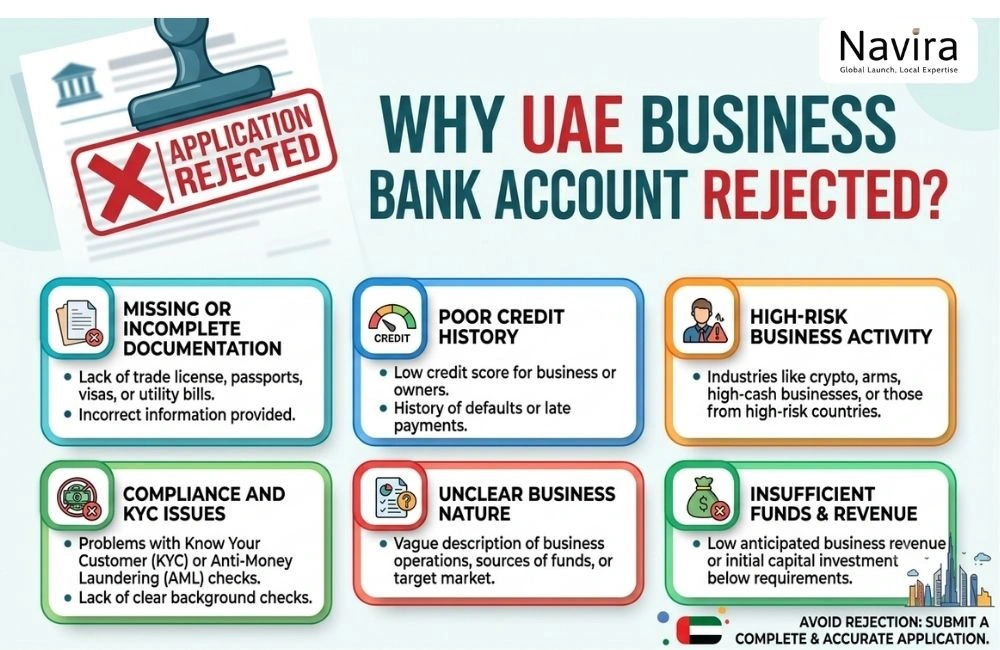
A UAE business bank account application is rarely declined for one isolated reason. Banks refuse or stall applications when they cannot build a complete, consistent risk picture of the company — its ownership, its real business activity, where its money comes from, and how it expects to move funds day to day. Under the Central Bank of the UAE’s (CBUAE) Consumer Protection Standards, a bank is generally required to disclose why it rejected an application — except when the reason relates to financial crime compliance, in which case the bank is legally permitted to withhold the detail. That one rule explains almost every vague “does not meet our risk appetite” letter founders receive. Most rejections are fixable once you identify which part of the compliance picture was missing and apply to a bank whose risk appetite genuinely matches the business.
What a Bank Rejection Actually Means
Founders often describe every delay as a “rejection,” but the right next step depends on what has actually happened to the file. A trade licence proves a company was legally established for stated activities; it does not obligate any bank to open an account for it. Each UAE bank runs its own customer-acceptance, compliance and risk assessment on every application, independently of the licensing authority.
| Status | What It Usually Means | Best Immediate Response |
|---|---|---|
| More information requested | The file is open; the bank needs documents or clarification. | Answer the exact request and make every attachment consistent with the original application. |
| Pending / manual review | The file is still being assessed or has been escalated internally. | Ask for a status update and any outstanding items. Do not submit a duplicate application. |
| Declined / closed | The bank has decided not to open this account through this application. | Ask which category of issue can be shared, and whether a corrected reapplication is possible. |
| Existing account restricted or closed | A different issue entirely — not an account-opening decision. | Use the bank’s formal complaints channel and seek specialist advice if funds or operations are affected. |
Soft Decline vs. Hard Rejection
- Soft decline: incomplete paperwork, an expired licence, an undated resolution, or a document that doesn’t match another document in the file. This is usually fixable within days once the specific gap is identified.
- Hard rejection: a confirmed sanctions or watchlist match, a business activity the bank does not bank at any price, or a structural issue the bank is not willing to underwrite. This typically requires a different bank, a different product, or a change to the company structure — not just better paperwork.
Why UAE Banks Got Stricter — and Why They Don’t Always Explain Why
The regulatory backdrop matters more here than most guides acknowledge, and it has moved substantially in the last 12 months:
- FATF status: the UAE was removed from the Financial Action Task Force’s “grey list” (Jurisdictions Under Increased Monitoring) on 23 February 2024, after being listed since March 2022. As of the FATF’s June 2026 plenary, the UAE remains off that list, which currently holds 22 jurisdictions. The UAE’s next full FATF mutual evaluation is expected in 2026, and banks are keeping their AML/CFT controls at the elevated standard built during the monitoring period rather than relaxing them.
- New AML law: Federal Decree-Law No. 10 of 2025 on Combating Money Laundering, the Financing of Terrorism, and the Financing of Arms Proliferation replaced the 2018 AML-CFT law, adding proliferation-financing offences and provisions aimed at illicit use of digital systems and virtual assets.
- New Central Bank law: Federal Decree-Law No. 6 of 2025 replaced the 2018 Central Bank law. Among other changes, it centralises consumer complaint handling through the Sanadak ombudsman framework and gives the Central Bank stronger, faster powers to act on institutional risk — which pushes banks toward more conservative onboarding decisions.
- Fresh CBUAE guidance: on 6 November 2025 the CBUAE issued updated Guidance for Licensed Financial Institutions on Customer Due Diligence, KYC and Recordkeeping, describing CDD/KYC as an ongoing, risk-based process that must continue throughout the banking relationship, not just at onboarding. A companion Guidance on Trade-Based Money Laundering and Transshipment risk followed on 26 November 2025, adding extra scrutiny for companies whose business involves cross-border trade flows.
- The disclosure rule that explains “vague” letters: clause 2.1.1.26 of the CBUAE Consumer Protection Standards requires a licensed financial institution to disclose its reason for rejecting a consumer’s application for a financial product — except where the reason relates to Financial Crime Compliance risk, or where disclosure is otherwise prohibited by law. In practice, this is precisely why so many rejection letters say “internal policy” or “does not meet our risk appetite” instead of naming the actual trigger: once a compliance officer categorises a decline as AML/financial-crime related, the bank is not obliged to explain further, and often legally discouraged from doing so.
How UAE Banks Actually Assess an Application
Every application moves through three layers of scrutiny, each with a different depth of review depending on the perceived risk:
- Know Your Customer (KYC) — verifying the identity of the company, its directors, shareholders and ultimate beneficial owners (UBOs), including screening against sanctions and watchlists.
- Customer Due Diligence (CDD) — understanding the business model, ownership structure, source of funds, and expected transaction activity well enough to assign a risk rating.
- Enhanced Due Diligence (EDD) — a deeper layer applied automatically to complex ownership chains, higher-risk sectors, higher-risk geographies, politically exposed persons, or any unresolved inconsistency found during CDD.
Under current CBUAE guidance, if a bank cannot complete the CDD it considers necessary for a given customer, or if it identifies a confirmed sanctions match, its guidance is that it should not onboard that customer at all — which is why an application can be declined even when nothing about the business is actually illegal.
The 10 Reasons UAE Business Bank Accounts Get Rejected — and the Fix for Each
These are diagnostic categories, not a claim about what any specific bank decided in your case. More than one commonly applies to the same file.
1. The licensed activity doesn’t match the real business
If your trade licence says “management consultancy” but your application, website or projected payments describe buying and selling physical goods, the bank cannot reconcile what you’re licensed to do with what you’re asking to bank. This is one of the single most common triggers across every UAE bank.
- Fix: write one accurate description of what you sell, to whom, and how you earn revenue, and make sure the licence, the website, the contracts and the bank application all tell that same story. If the real activity isn’t covered by your current licence, resolve that with your free zone or the DED before reapplying — don’t try to solve a licensing gap with careful wording.
2. Documentation is incomplete, expired, or inconsistent
A trade licence expiring inside the review window, a passport that doesn’t match the Emirates ID after a renewal, an undated board resolution, or a shareholding percentage that differs between two documents can each trigger an automatic hold or decline before a human reviewer even reaches the substance of the file.
- Fix: request the bank’s exact product checklist and build a one-page document index. Reconcile names, dates, addresses, ownership percentages and signing authority line by line before you submit anything. Explain any genuine discrepancy (a renewed passport, a changed address) with supporting evidence rather than leaving the bank to guess.
3. The ownership or UBO structure is unclear
CBUAE guidance requires banks to trace ownership through every corporate layer until they reach the natural persons who ultimately own or control the company. A missing shareholder, a percentage that doesn’t match registry records, or an unexplained trust or nominee arrangement will pause or end the application.
- Fix: prepare a dated ownership chart showing every entity and percentage down to the individual owners, supported by the underlying registers and identity documents. Be ready to explain, in plain commercial terms, why the structure exists and who actually controls the account.
4. Source of funds or source of wealth isn’t evidenced
“Personal savings” or “shareholder loan” explains the origin of capital in one sentence; it doesn’t prove it. Banks want a traceable line from an economic event (salary, dividend, asset sale, loan) to the funds landing in the account.
- Fix: provide the underlying record for each source — the loan agreement and lender’s own funding trail, the dividend statement, the sale agreement, the salary and bank statements — not just a declaration. Never move cash between accounts shortly before applying purely to “tidy” the trail; that pattern is exactly what AML monitoring is built to flag.
5. The business narrative or plan is generic
A licence activity of “general trading” paired with a templated business plan tells a compliance officer almost nothing. Vague plans, inconsistent explanations given to different staff, or claims not backed by any commercial evidence are a recurring rejection trigger, particularly for new companies.
- Fix: write a focused two-to-four-page narrative that names your target customers, your suppliers, your pricing and delivery model, and why the UAE is the right base for the business. Attach whatever real evidence exists — signed contracts, letters of intent, purchase orders or invoices — and clearly label any forward-looking estimate as an estimate.
6. The expected transaction profile is vague or implausible
CBUAE guidance expects banks to collect and assess anticipated transaction values, volumes, currencies and geographies, and to monitor actual activity against that profile afterward. Round, unexplained figures, or a brand-new microbusiness forecasting large cross-border volumes with no supporting contracts, read as implausible.
- Fix: prepare a twelve-month transaction map — monthly value ranges, payment counts, currencies, countries and counterparty types — tied to actual pricing, capacity and any signed work. Disclose cash handling, third-party payments or pass-through funds rather than omitting them.
7. Little verifiable UAE presence or substance
A company with no credible website, no dedicated business email, and shareholders who have never visited the UAE gives a bank little to verify. This is often (incorrectly) reduced to “virtual offices get rejected” — in reality, a virtual or flexi-desk address is legally valid for licensing, and its acceptability for banking varies by bank, product and the rest of the file, not by a blanket rule.
- Fix: make sure your address evidence (lease, Ejari, flexi-desk agreement) reconciles cleanly with your licence and application, and support the operating story with a working website, a business email domain, and any staffing, premises or supplier evidence that genuinely exists.
8. High-risk sector or high-risk geography exposure
Certain activities automatically trigger Enhanced Due Diligence: virtual assets and crypto, money exchange and remittance, precious metals, cash-intensive retail, real-estate brokerage, and cross-border trade routes through higher-scrutiny jurisdictions. This doesn’t make an account impossible — it means the standard document pack won’t be enough.
- Fix: lead with any regulatory status you hold (for example, a VARA licence for a crypto-related activity), and prepare the enhanced pack — detailed transaction narrative, counterparty and jurisdiction detail, and AML policy where relevant — before the bank has to ask for it.
9. Screening matches, adverse history or prior banking problems
Every applicant is automatically screened against sanctions and watchlists (OFAC, UN, EU and domestic lists) and, for individuals, credit history through the Al Etihad Credit Bureau (AECB). A partial name match, a prior account that was closed involuntarily, or an unresolved credit default linked to a shareholder will surface here.
- Fix: pull your own AECB report before applying and resolve any outstanding issue directly with the relevant institution first. If you believe a screening match is a false positive (a common name collision, for example), gather identity evidence that clearly distinguishes you from the flagged party and be ready to provide it proactively.
10. Wrong bank or wrong product for the company’s profile
A company can be entirely legitimate and still fail a specific bank’s or a specific product’s eligibility criteria — currency support, ownership-complexity limits, turnover segment, or the free zone’s compliance familiarity with that particular bank. Applying to a bank that rarely sees your free zone’s licence format is one of the most avoidable causes of decline.
- Fix: check the bank’s live eligibility criteria for legal form, ownership layers, turnover and currency needs before applying, and where possible, choose a bank or digital-first provider that already has volume experience with your specific free zone or sector.
What To Do After a Rejection — Step by Step
- Confirm the actual status using the table in Section 1 — don’t assume a request for more information is a decline.
- Ask the bank which category of issue applies. You are entitled to a reason under CBUAE Consumer Protection Standards clause 2.1.1.26 — unless the bank categorises the decline as financial-crime-compliance related, in which case it can lawfully decline to elaborate.
- Do not submit the same file to several banks at once. UAE banks share compliance signals through common screening databases and industry practice; near-simultaneous applications read as evasive rather than diligent, and can make every application harder, not easier.
- Identify and fix the specific gap using Section 4 above, rather than simply resubmitting the same pack with a cover letter.
- If you believe the bank acted unfairly (discrimination, a clearly false screening match, or a service failure) you can escalate through Sanadak, the CBUAE-established financial ombudsman — but be aware its own rules exclude complaints that materially relate to a bank’s risk management, internal pricing, or anti-money-laundering policies and practices, and you must generally raise the issue with the bank directly first and allow a defined response period before Sanadak will accept the case.
- Reapply to a bank whose risk appetite and free-zone familiarity actually match your company’s profile, with a corrected, internally consistent file.
Building a Bank-Ready Application File
Exact requirements vary by bank and product, so treat this as a baseline to confirm against the specific bank’s current checklist.
| Company Type | Core Documents to Prepare |
|---|---|
| All companies | Valid trade licence (well inside expiry) • Certificate of Incorporation • MOA/AOA • Share certificate(s) • Passport copies for all shareholders and directors • Proof of address • Dated, signed board resolution • Two-to-four-page business plan • Source-of-funds evidence • 6–12 months of personal bank statements for shareholders |
| Free zone companies | Lease / Ejari or flexi-desk agreement • Free zone establishment card where applicable |
| Mainland companies | DED trade licence (original and copy) • Ejari-registered tenancy contract • Local service agent agreement, if applicable |
| Higher-risk activities | Relevant regulatory approval (e.g., VARA for virtual assets) • Sample contracts or purchase orders • Supplier and counterparty jurisdiction detail • AML/compliance policy document |
| Non-resident or complex-nationality shareholders | Apostilled or notarised passport copy • Source-of-wealth declaration covering overall financial history • Home-country bank reference letter • Professional background documentation |
Choosing the Right Bank
Traditional banks and newer digital-first banks apply meaningfully different risk models. Treat the ranges below as directional — confirm current minimum balances, fees and timelines directly with each bank before applying, since these terms change.
| Factor | Traditional Banks (e.g., Emirates NBD, FAB, ADCB, Mashreq) | Digital-First / Challenger Banks (e.g., Wio, Mashreq Neo, Zand, Liv) |
|---|---|---|
| Trading history | Often prefer 6+ months of operating history | New companies with no trading history generally accepted |
| Onboarding | In-branch relationship-manager led, document-heavy | Fully digital, app-based onboarding |
| Typical timeline | Several weeks, longer for complex cases | Often days to roughly two weeks |
| Minimum balance | Typically higher; varies by bank and segment | Often zero or low minimum balance |
| Best fit | Established companies, higher-turnover or trade-finance needs | New free-zone companies and startups building a track record |
A practical sequencing strategy for a brand-new company: open with a digital-first bank to establish 6–12 months of real transaction history, invoices and payment flow, then approach a traditional bank for trade finance, larger credit facilities, or multi-currency needs once that track record exists.
Frequently Asked Questions
Does a bank have to tell me why my application was rejected?
Generally yes. CBUAE Consumer Protection Standards require a licensed financial institution to disclose the reason for rejecting an application for a financial product or service — except where the reason relates to financial crime compliance risk, or where the law otherwise prohibits disclosure. That exception is why many rejection letters are deliberately vague.
Is a UAE bank account rejection permanent, or does it get recorded as a blacklist?
A decline from one bank is not, by itself, evidence of a government-wide blacklist, and it does not appear on your AECB credit file. Banks do keep their own internal records and conduct independent risk decisions, so an unresolved issue can resurface if it isn’t actually fixed before you reapply.
Can I apply to several UAE banks at the same time to improve my odds?
This is generally discouraged. Submitting near-identical applications to multiple banks within a short window tends to increase scrutiny rather than improve approval odds, since it can read as an attempt to obscure information or as evidence of a prior decline. A sequential approach — one well-matched bank at a time, fixing issues between attempts — performs better in practice.
Does a virtual office or flexi-desk automatically cause rejection?
No universal rule supports that claim, despite how often it’s repeated. A virtual or flexi-desk address is legally valid for free-zone licensing, and its effect on a banking application depends on the specific bank, product and the strength of the rest of the file — not on the address type alone.
Can a company with a non-resident or foreign shareholder still open a UAE business account?
Yes. Eligibility depends on the bank, product, ownership structure and evidence provided, not on nationality or residency alone. Higher-scrutiny nationalities under FATF-linked frameworks typically need a stronger enhanced due diligence pack — apostilled documents, a source-of-wealth declaration and a home-country bank reference — rather than facing an automatic bar.
How long does it take to get approved after a rejection is resolved?
There’s no universal figure; it depends on the bank, the company profile and how completely the underlying issue was fixed. Digital-first banks can move in days once documentation is complete; traditional banks and higher-risk profiles typically take several weeks.
What is Sanadak, and can it overturn a bank’s rejection?
Sanadak is the independent ombudsman unit established by the CBUAE to resolve consumer complaints against licensed financial institutions, free of charge. It is a useful channel for service failures, discrimination, or clearly mishandled applications — but its own rules exclude complaints that materially concern a bank’s risk management, internal pricing, or AML policies and practices, which covers most compliance-driven account declines.
Is a trade licence enough to guarantee a business bank account?
No. A trade licence proves the company is legally permitted to operate; it does not obligate any bank to open an account. Each bank runs its own KYC, CDD and, where relevant, enhanced due diligence before deciding whether to accept the relationship.
Key Takeaways
- Most rejections are a risk-assessment outcome specific to one bank at one point in time — not a permanent judgment on the business.
- Banks are generally required to disclose the reason for a decline, except when the reason is financial-crime-compliance related — which explains most vague rejection letters.
- The UAE’s post-2024 regulatory environment (new AML law, new Central Bank law, and CBUAE’s November 2025 CDD guidance) has pushed every bank toward more conservative, more thoroughly documented onboarding.
- Fix the specific, identifiable gap — activity mismatch, documentation, UBO clarity, source of funds, business narrative, transaction profile, substance, risk sector, screening, or bank fit — rather than resubmitting the same file elsewhere.
- Sequence your applications. One well-matched bank at a time, with a corrected and internally consistent file, outperforms applying everywhere at once.


