

Get Response within 60 Seconds.
Share a few details and get an instant response — one of our setup advisors will follow up with your personalized breakdown right away
| The short answerOwnership no longer decides this choice — both jurisdictions allow 100% foreign ownership. Three things do: where your customers are, how your income is taxed, and how many people you plan to hire.Choose mainland if you sell directly to UAE consumers, chase government contracts, or plan to scale headcount past 50 people.Choose a free zone if you trade internationally, want a shot at the 0% Qualifying Free Zone Person tax rate, or want to stay outside MOHRE’s Emiratisation quota — which is currently mainland-only.Since March 2025, a free zone company (outside DIFC) can also trade directly on the Dubai mainland through a branch license, without giving up its free zone status. Most guides online still don’t reflect this. |
Why This Decision Is Harder Than Most Guides Make It Look
Every founder incorporating in Dubai hits the same fork in the road: free zone or mainland. For years, the internet’s answer was simple — free zone for 100% ownership, mainland if you needed a local sponsor. That answer is now obsolete on both counts. Full foreign ownership arrived for most mainland activities in June 2021. Federal corporate tax arrived in June 2023 and ended the blanket free zone exemption. And in March 2025, a resolution most published comparisons still haven’t caught up with quietly rewrote the biggest structural limitation free zones had — the inability to trade directly with mainland customers.
This guide reflects the rules in force as of August 2026, cross-checked against primary sources: the UAE Ministry of Finance, the Federal Tax Authority, the UAE government portal (u.ae), MOHRE, and the Dubai Department of Economy and Tourism (DET). Figures for setup packages change by zone and by promotion, so treat the cost ranges here as a planning baseline and confirm the exact package price before you commit.
What Is a Free Zone Company vs a Mainland Company?
Free Zone Company
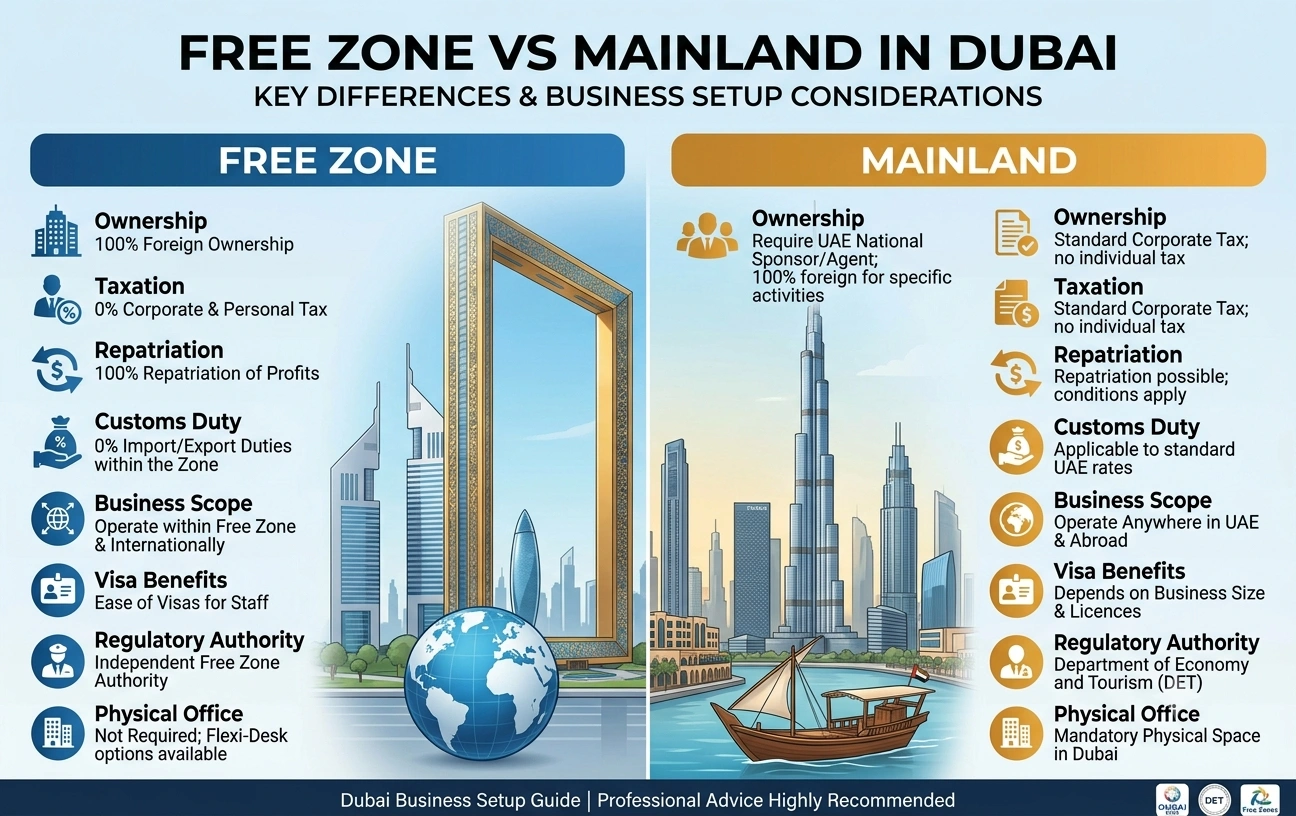
A free zone company is licensed by an individual Free Zone Authority — DMCC, JAFZA, IFZA, Dubai South, Meydan, DIFC, Dubai Silicon Oasis, and more than 40 others across the UAE, each built around specific sectors such as commodities, finance, media, logistics, or technology. Free zones offer 100% foreign ownership by design, simplified setup, flexible office packages (including flexi-desks and virtual offices), and full repatriation of profits and capital.
Mainland Company
A mainland company is licensed by the Dubai Department of Economy and Tourism (DET, formerly DED) and operates under the UAE Commercial Companies Law — Federal Decree-Law No. 32 of 2021, in force since 2 January 2022. It replaced the older 2015 companies law and runs to 365 articles across 12 titles. A mainland license allows trading anywhere across all seven emirates, with no zone boundary, and is the only route to UAE government and semi-government contracts.
Free Zone vs Mainland: The Full Comparison Table (2026)
| Factor | Free Zone | Mainland |
|---|---|---|
| Regulator | Individual Free Zone Authority (DMCC, IFZA, JAFZA, DIFC, Meydan, RAKEZ, etc.) | Dubai Department of Economy and Tourism (DET) |
| Foreign ownership | 100% since inception, every activity | 100% for most activities since 1 June 2021; a short restricted list still requires Emirati participation |
| Governing law | Free Zone Authority regulations, specific to each zone | Federal Decree-Law No. 32 of 2021 (Commercial Companies Law) |
| UAE market access | Restricted; needs a distributor, mainland branch, or Resolution 11 authorization | Full and unrestricted across all seven emirates |
| Direct mainland trading | Now possible via branch license or temporary permit (Resolution 11 of 2025) — see below | Native; no additional authorization needed |
| Government & semi-government contracts | Not directly; requires a DET-licensed mainland branch | Yes |
| Corporate tax | 0% for a Qualifying Free Zone Person (QFZP) on qualifying income; 9% otherwise | 0% on profit up to AED 375,000; 9% above that threshold |
| VAT | 5%, UAE-wide; Designated Zone rules affect goods, not services | 5%, standard rules |
| Customs duty | Exempt in-zone and on re-export; 5% applies once goods enter the mainland | Standard 5% import duty applies |
| Emiratisation quota (MOHRE) | Generally exempt from mandatory quotas as of 2026 | Mandatory for 50+ employee firms (10% skilled roles by end-2026) and for 20–49 employee firms in 14 designated sectors |
| Office requirement | Flexi-desk, co-working, or virtual office — often no physical space required | Physical office with an Ejari-registered tenancy contract |
| Visa quota | Fixed by license package and office type | Scales with leased office space, under MOHRE rules |
| Typical first-year cost | Roughly AED 18,000–34,000, license bundled with visas/desk | Roughly AED 30,000–45,000+, driven by office lease and approvals |
| Setup speed | Often 3–10 working days | Can take longer due to office lease and activity approvals |
Sources: UAE government portal (u.ae), UAE Ministry of Finance, Federal Tax Authority, MOHRE, Dubai DET, and setup-cost data compiled from Free Zone Authority and DET fee schedules current as of mid-2026.
Foreign Ownership: The Rule Everyone Still Gets Wrong
Since 1 June 2021, most Dubai mainland activities allow 100% foreign ownership, under Federal Decree-Law No. 26 of 2020, which amended the Commercial Companies Law and removed the default 51% Emirati shareholder requirement. Dubai Economy has reported that more than 1,000 commercial and industrial activities were opened to full foreign ownership as a result. Free zones have always granted 100% foreign ownership by design, so on this specific point, the two jurisdictions have effectively converged.
The Activities That Still Require Emirati Participation
A narrow list of “strategic impact” activities is excluded from the 2021 reform and still requires majority or full Emirati ownership, including:
- Security and defense-related activities
- Banking and insurance
- Currency printing
- Telecommunications
- Hajj and Umrah services
- Quran memorization centers
- Fisheries services (this one requires 100% UAE national ownership, per the UAE Ministry of Economy and Tourism)
Outside this list, some regulated professional licenses still appoint a Local Service Agent (LSA) — an Emirati individual paid a fixed annual fee who holds no equity and has no say in the business. This is a licensing formality for civil-company structures in regulated professions, not the old 51% shareholding sponsor arrangement, and it applies far less often since the 2021 reform.
Corporate Tax: What Actually Changed in 2023 — and What It Means Now
Both jurisdictions sit inside the UAE’s federal corporate tax regime, effective for financial years starting on or after 1 June 2023, under Federal Decree-Law No. 47 of 2022 (issued 9 December 2022). The headline rate is 0% on taxable profit up to AED 375,000 and 9% above that threshold, per the UAE Ministry of Finance. This ended the assumption that a free zone company is automatically tax-free — it isn’t, unless it separately qualifies for a special status.
The Qualifying Free Zone Person (QFZP) Test
A free zone company keeps a 0% rate on its qualifying income only if it meets every condition below, as a Qualifying Free Zone Person. Fail one, and the standard 9% applies to all profit, not just the disqualifying portion.
| Condition | What it requires |
|---|---|
| Adequate substance | Core income-generating activities and resources (staff, assets, operations) must actually sit in the free zone |
| Qualifying income | Income must come from qualifying activities; income from mainland customers is generally excluded and can jeopardize QFZP status |
| De minimis limit | Non-qualifying revenue must stay below the lower of AED 5,000,000 or 5% of total revenue (Cabinet Decision No. 100 of 2023) |
| No standard-rate election | The company must not have voluntarily elected to be taxed at the standard 9% rate |
| Transfer pricing compliance | Related-party transactions must be priced at arm’s length, with documentation maintained (Federal Decree-Law No. 47 of 2022) |
This is exactly where Resolution 11 (below) creates a genuine trade-off: mainland revenue earned through a free zone company’s new branch license counts as non-qualifying income against that de minimis cap. Trade too much on the mainland and a company can accidentally forfeit its 0% rate on everything else.
VAT Applies to Both — No Exceptions
Value Added Tax at 5% has applied UAE-wide since 1 January 2018, to free zone and mainland companies alike, per the Federal Tax Authority. VAT registration is mandatory once taxable supplies pass AED 375,000, and voluntary from AED 187,500. “Designated Zone” rules give certain free zones special VAT treatment for the movement of goods, but this doesn’t extend to services, and it does not make a free zone company VAT-free.
2025’s Biggest Change: Free Zone Companies Can Now Trade Directly on the Mainland
| Why most comparison guides are already out of dateOn 3 March 2025, Dubai’s Crown Prince Sheikh Hamdan bin Mohammed issued Executive Council Resolution No. 11 of 2025, giving free zone companies a direct legal path to mainland trading — something that was previously blocked outright or only possible through a costly distributor.Before this, a free zone company selling to mainland customers typically paid a local distributor 15–25% commission per transaction, or set up and ran a second, fully separate mainland entity. |
The resolution applies to free zone companies across Dubai, with one notable exception: the Dubai International Financial Centre (DIFC) is excluded, since it operates under its own independent legal and judicial framework. Every other Dubai free zone — DMCC, JAFZA, IFZA, Dubai South, Dubai Silicon Oasis, and the rest — falls under it. By 3 September 2025, DET had published the approved-activities list specifying which activities qualify for a branch license versus a temporary permit, so it’s worth checking a specific activity against that list before assuming eligibility.
Three Ways a Free Zone Company Can Now Access the Mainland
| Pathway | Annual cost | Physical mainland office? | Best fit |
|---|---|---|---|
| Branch license — physical presence | AED 10,000 license + office rent (typically AED 20,000–50,000+) | Yes, mandatory | Retail, showrooms, clinics, and any business where customers expect to visit in person |
| Branch license — operating from the free zone | AED 10,000 (no added office cost) | No — trades under full mainland authorization from the existing free zone premises | E-commerce fulfilment, B2B and professional services, SaaS, trading — most digitally-delivered or remote-service businesses |
| Temporary activity permit | AED 5,000 for up to 6 months (non-renewable, but convertible to a full branch license) | No | Market testing, pilot projects, and short, defined mainland contracts before committing to a permanent structure |
For most digitally-delivered businesses, the branch-from-free-zone option is the standout: full mainland market access for roughly AED 10,000 a year, with no separate office. Compare that to the old distributor model — on AED 500,000 of mainland revenue, a 20% distributor commission cost AED 100,000 a year. The branch license route retains AED 490,000 of that same revenue, a saving of roughly AED 90,000 annually once the license fee is accounted for. The rough break-even point for the branch license is around AED 50,000 in annual mainland revenue; below that, a temporary permit is the cheaper test.
Compliance Conditions That Come With Mainland Access
- Comply with all mainland regulations relevant to the licensed activity, including any sector-specific rules
- Keep separate financial records for mainland operations, distinct from free zone accounts
- Obtain a separate authorization for each additional emirate — this resolution covers Dubai mainland only
- Accept joint oversight from DET and the originating Free Zone Authority; non-compliance risks fines or revocation
Free zone companies that were already operating on the mainland before the resolution had to regularize their status by 3 March 2026, the one-year compliance deadline, with a possible one-time extension if applied for before that date.
Customs Duties: In-Zone Exemption vs Standard Mainland Rates
Goods imported into a free zone and re-exported without entering the mainland are exempt from the UAE’s standard 5% customs duty. The exemption ends the moment goods leave the free zone and enter mainland circulation — at that point, the standard 5% import duty applies, whether the goods originated in a free zone or came directly from overseas. This makes free zones a natural fit for re-export, transshipment, and regional distribution businesses, while mainland companies pay duty at the point of import as a matter of course.
Emiratisation: The Overlooked 2026 Factor That Favors Free Zones
This is the piece almost no free-zone-vs-mainland comparison mentions, and it materially changes the calculus for any company planning to scale headcount in 2026. Emiratisation is a MOHRE-enforced mainland policy. As of 2026:
- Mainland private-sector companies with 50 or more employees must reach 10% Emirati representation in skilled roles by 31 December 2026, delivered in two 1-percentage-point steps across the year (30 June and 31 December).
- Mainland companies with 20–49 employees operating in 14 designated sectors (including finance, real estate, and IT) must hire at least 2 Emirati nationals.
- The minimum monthly salary for an Emirati employee counted toward the quota is AED 6,000, effective 1 January 2026.
- Non-compliant companies pay a monthly financial contribution per unfilled position, which has risen each year and now runs into several thousand dirhams per role, per MOHRE’s published penalty structure.
Free zone companies are currently exempt from mandatory MOHRE Emiratisation quotas, as the framework is built around mainland labor registration. DIFC and ADGM run their own separate employment regulations. This exemption is a genuine, current-cost advantage for growth-stage free zone companies with larger teams — though the direction of UAE labor policy over the past four years suggests this carve-out shouldn’t be assumed to be permanent. Any company choosing mainland specifically to scale headcount should build Emiratisation compliance into its hiring plan and budget from year one, not retrofit it later.
Real Setup Costs in 2026: Free Zone vs Mainland
Package prices move frequently and vary by zone, activity, and promotion — treat the figures below as a planning range, and confirm the exact quote before budgeting.
Free Zone Cost Breakdown
| Cost component | Typical 2026 range |
|---|---|
| Trade license fee | AED 9,000 – 15,000, depending on activity and zone |
| Budget-tier packages (e.g., IFZA, SHAMS) | From roughly AED 5,750 – 11,900, depending on visa allocation |
| Flexi-desk / shared workspace | AED 3,000 – 7,000 per year |
| Visa cost (per visa) | AED 3,000 – 5,000, covering medical testing, Emirates ID, and stamping |
| Establishment card | AED 1,000 – 2,000 |
| Corporate bank account assistance (optional) | AED 2,000 – 5,000 |
| Total first-year estimate | Roughly AED 18,000 – 34,000 |
Mainland Cost Breakdown
| Cost component | Typical 2026 range |
|---|---|
| DET trade license fee | AED 12,000 – 25,000+, depending on activity and external approvals |
| Low-cost trade license route (e.g., certain e-commerce/freelance categories) | From around AED 1,070, plus Dubai Chamber membership |
| Physical office lease + Ejari registration | Highly variable by location; Ejari registration itself is AED 220 |
| Visa cost (per visa) | AED 3,000 – 5,000 |
| Establishment card | AED 1,000 – 2,000 |
| Legal documentation (MOA, attestations where required) | Varies by legal form and activity |
| Total first-year estimate | Often AED 30,000 – 45,000+, driven mainly by the office lease |
The gap between the two narrowed considerably after 2021, since most mainland companies no longer pay a local sponsor. What mainland money buys today is unrestricted market access and a physical footprint, not ownership rights that free zones lack.
Visa Quotas: Package-Based vs Space-Based
Free zone visa allocations are fixed by the license package and office type chosen at setup — a flexi-desk typically allows only a small handful of visas. Mainland visa capacity scales with leased physical office space under MOHRE rules: more square footage generally means a larger visa quota, with no zone-imposed ceiling. This is one reason mainland tends to suit businesses planning to scale headcount significantly, alongside the Emiratisation trade-off covered above.
Government Contracts: Mainland-Only, With One Workaround
UAE government and semi-government tenders require a mainland license — a free zone company cannot bid directly. The workaround is the same branch-license mechanism introduced by Resolution 11: a free zone company can register a DET-licensed mainland branch and become eligible to bid through that branch, without dissolving its original free zone entity.
How to Decide: A Practical Framework
Work through these questions in order. Each one narrows the decision faster than generic pros-and-cons lists.
- Where are your customers? If most revenue comes from UAE-based consumers or businesses, mainland (or a free zone with a Resolution 11 branch license) is the realistic starting point.
- Do you need government or semi-government contracts? If yes, you need a mainland license — either directly, or via a branch of your free zone company.
- Can your income realistically qualify as a Qualifying Free Zone Person? If your revenue is genuinely international and stays under the de minimis threshold, a free zone protects a 0% tax rate that a mainland company cannot access.
- How many people will you employ in year one to three? Plans to scale past 50 mainland employees bring Emiratisation quotas into the budget; a free zone currently sits outside that requirement.
- What’s your realistic mainland revenue, if any? Below roughly AED 50,000 a year, a temporary activity permit is cheaper than a full branch license. Above it, the branch license pays for itself quickly.
- What are your cost and office needs today? A free zone entry is usually cheaper and faster; mainland buys a physical footprint and unrestricted access from day one.
| A common 2026 pattern worth knowingA growing number of founders now set up in a free zone to protect the 0% QFZP rate and stay outside Emiratisation quotas, then add a Resolution 11 branch license the moment mainland demand justifies the AED 10,000 annual fee — getting free zone tax treatment and mainland market access from a single underlying entity, without running two separate companies. |
What About a “Dual License”?
Before Resolution 11, some free zones offered dual-license arrangements — a partnership between a specific free zone and the DET that let a free zone company obtain a companion mainland license without a full second incorporation. These arrangements still exist in some zones, but for most businesses, Resolution 11’s branch license is now the more direct, UAE-wide-recognized route to the same outcome, since it’s backed by an Executive Council resolution rather than a bilateral zone agreement. If a specific free zone already has a dual-license partnership you’re being offered, compare its cost and scope directly against the AED 10,000 branch license before choosing.
Frequently Asked Questions
Is a Dubai free zone company tax-free in 2026?
No. A free zone company reaches 0% tax only as a Qualifying Free Zone Person earning qualifying income under Federal Decree-Law No. 47 of 2022. All other profit is taxed at 9% above AED 375,000. Mainland-customer income generally does not count as qualifying income.
Do I still need a UAE national sponsor for a mainland company?
No, for most activities. Since 1 June 2021, Federal Decree-Law No. 26 of 2020 allows 100% foreign ownership for most Dubai mainland activities. A local Emirati shareholder is required only for a short list of strategic-impact activities such as defense, banking, insurance, and telecommunications.
Can a free zone company do business in mainland Dubai now?
Yes, since Executive Council Resolution No. 11 of 2025. A free zone company (outside DIFC) can obtain a branch license — with or without a physical mainland office — or a short-term temporary activity permit, giving it direct legal access to mainland customers without a distributor or a second incorporation.
Does taking on mainland revenue affect a free zone company’s tax status?
It can. Mainland-sourced revenue generally counts as non-qualifying income for corporate tax purposes. If it pushes total non-qualifying revenue above the lower of AED 5,000,000 or 5% of total revenue, the company loses Qualifying Free Zone Person status and the standard 9% rate applies to all of its profit, not just the mainland portion.
Which is cheaper to set up: free zone or mainland?
Free zone is typically cheaper at entry — roughly AED 18,000–34,000 in year one, often bundled with a desk and a visa or two. Mainland typically runs AED 30,000–45,000+ in year one, driven mainly by the physical office lease that Ejari registration requires.
Do free zone companies have to meet Emiratisation quotas?
Generally, no. Emiratisation quotas are enforced by MOHRE for mainland private-sector employers — 10% skilled-role representation by end-2026 for firms with 50+ employees. Most free zones, along with DIFC and ADGM under their own frameworks, currently sit outside this mandatory quota, though the requirement has expanded steadily each year.
Can a free zone company bid on UAE government contracts?
Not directly. Government and semi-government tenders require a mainland license. A free zone company can become eligible by registering a DET-licensed mainland branch under the same Resolution 11 framework used for commercial mainland trading.
Do free zone companies pay VAT?
Yes. VAT at 5% has applied UAE-wide since 1 January 2018, to free zone and mainland companies alike. Mandatory registration applies once taxable supplies pass AED 375,000. Designated Zone rules affect the VAT treatment of goods, not services, so a free zone is not VAT-free.
Can I convert a free zone company into a mainland company?
There’s no direct one-step conversion. The practical options are registering a new, separate DET-licensed mainland company, or — since March 2025 — obtaining a mainland branch license under Resolution 11, which extends market access without dissolving the original free zone entity.
The Bottom Line
Ownership stopped being the dividing line in 2021, and blanket tax exemption stopped being the dividing line in 2023. What decides free zone versus mainland in 2026 is a combination of where revenue actually comes from, whether that revenue can be structured to qualify for the 0% QFZP rate, and how many people the business plans to employ under a regime that now treats mainland and free zone headcount very differently. Resolution 11 of 2025 adds a third path that didn’t exist two years ago: starting in a free zone for the tax and Emiratisation position, then adding mainland access only once it’s actually needed, at a fraction of the cost a distributor or a second entity would have required.
This guide is for general information and reflects UAE federal and Dubai-emirate rules current as of August 2026. It is not legal, tax, or immigration advice. Corporate tax, Emiratisation targets, and free zone package pricing are updated periodically — confirm current figures with the UAE Ministry of Finance, the Federal Tax Authority, MOHRE, or a licensed UAE company-formation advisor before acting.
Publishing & SEO Checklist
Use this to get the article live in a way that supports ranking stability, not just the writing itself.
Suggested metadata
| Element | Suggested value |
|---|---|
| Title tag (≤60 chars) | Free Zone vs Mainland Dubai: 2026 Guide & Cost Breakdown |
| Meta description (≤155 chars) | Free zone vs mainland Dubai compared for 2026: ownership, 9% tax, Resolution 11 mainland access, Emiratisation, and real setup costs. |
| URL slug | /free-zone-vs-mainland-dubai |
| Primary keyword | free zone vs mainland dubai |
| Secondary keywords | dubai mainland vs free zone, free zone company mainland business, UAE corporate tax free zone, business setup cost dubai 2026 |
Structured data
- Add FAQPage schema for the Frequently Asked Questions section — it’s written in clean Q&A pairs specifically so it maps directly to schema.
- Add Article schema with datePublished / dateModified — update dateModified whenever a figure (tax threshold, Emiratisation %, license fee) changes, since freshness on regulatory content is a stronger signal than word count.
- Consider BreadcrumbList schema if this sits inside a broader UAE business-setup content hub.
Why this should hold its ranking rather than fluctuate
- It answers the query directly in the first 100 words (the callout box), which is what featured snippets and AI answer engines pull from — don’t bury the direct answer under a long history lesson.
- It cites primary sources by name (Federal Decree-Law numbers, MOF, FTA, MOHRE, DET) rather than only linking to other blogs — this is the single biggest gap versus most ranking competitors and the easiest E-E-A-T signal to replicate.
- It covers two 2025–2026 regulatory changes — Resolution 11 mainland access and 2026 Emiratisation quotas — that are largely absent from currently-ranking pages, giving the piece unique ground instead of only re-stating what’s already ranking.
- Update the dateModified and re-verify the AED figures, Emiratisation percentage, and QFZP thresholds roughly every quarter. Dated compli


