

Get Response within 60 Seconds.
Share a few details and get an instant response — one of our setup advisors will follow up with your personalized breakdown right away
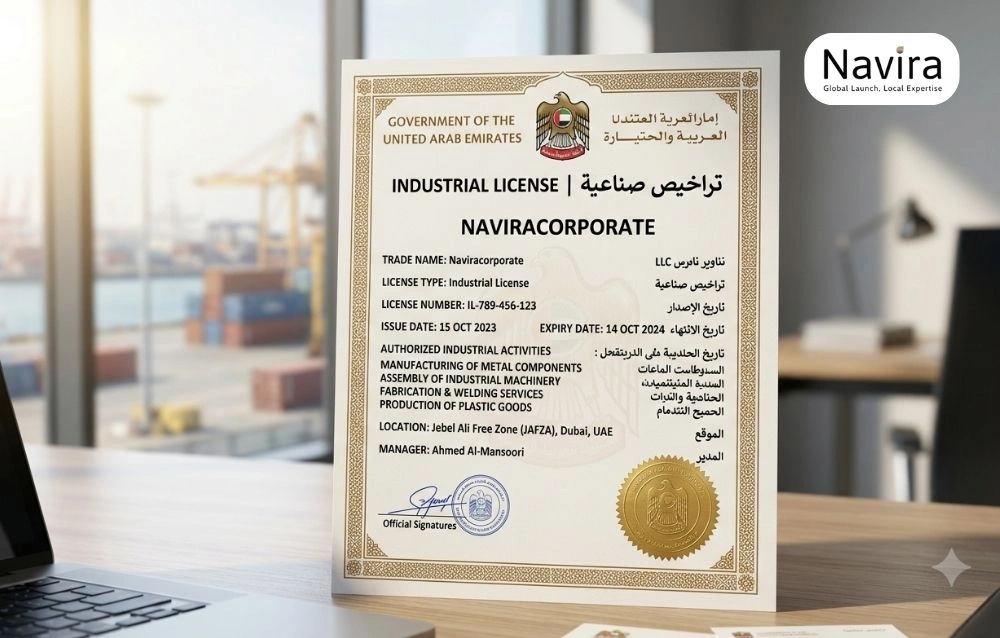
An industrial license in the UAE is a manufacturing permit that lets a company import raw materials, run a production, processing or assembly operation, and sell the finished goods locally and abroad. It is issued either by Dubai’s Department of Economy and Tourism (DET) for mainland companies, or by a free zone authority such as JAFZA, RAKEZ, SAIF Zone or KEZAD. Most manufacturers also need a second, federal-level registration — the MOIAT Industrial Production Certificate — to unlock customs duty relief on imported machinery and raw materials. In 2026, the license itself typically costs AED 15,000–25,000 on the mainland (with a lower renewal fee after April 2026) and anywhere from roughly AED 5,000 to AED 18,000+ per year across free zones, before warehouse or plant rent, which has climbed sharply as UAE industrial and logistics space has tightened.
What Is an Industrial License in the UAE?
An industrial license — sometimes called a manufacturing license — authorizes a company to transform raw materials or components into finished or semi-finished goods. It covers production, assembly, processing, packaging, and the associated import of raw materials and export of finished products. It sits alongside the two other core UAE license categories: commercial licenses (trading and resale of goods without transformation) and professional licenses (services and consultancy).
The defining feature of an industrial license, in every emirate and every free zone, is that it cannot be issued without a physical production facility. A virtual office or flexi-desk is never sufficient — regulators require a leased warehouse, factory unit, or industrial plot, along with proof that the space meets health, safety and environmental (HSE) standards before the license is granted.
Typical activities licensed under this category include food and beverage processing, textiles and garments, plastics and packaging, metal fabrication, furniture and wood products, chemicals, construction materials, pharmaceuticals and medical devices, electronics assembly, and automotive parts manufacturing.
The Two Licenses You Actually Need
Almost every guide to industrial licensing in the UAE stops at the local license — the one issued by DET or a free zone authority. That license makes your manufacturing activity legal. It does not, by itself, unlock the UAE’s main industrial incentive: duty-free import of machinery and raw materials.
1. The Local Industrial License
Issued by DET (mainland) or a free zone authority. This is the license that appears on your trade license certificate, lets you sign leases, sponsor visas, and open a bank account. It is jurisdiction-specific and renews annually.
2. The MOIAT Industrial Production Certificate
Issued separately by the federal Ministry of Industry and Advanced Technology (MOIAT), this certificate registers your factory in the UAE’s national industrial register. It is applied for online through the MOIAT digital services platform, moiat.gov.ae, after your local license is already in hand.
To qualify, MOIAT generally requires:
- A minimum capital of AED 250,000, evidenced in the company’s Memorandum of Association
- A minimum workforce of 10 employees
- Factory blueprints, a manufacturing process flow chart, and equipment specifications
- A physical inspection of the facility by a MOIAT inspector before the certificate is issued
The payoff: once registered, the factory becomes eligible for a customs duty waiver — commonly cited at around 5% — on imported machinery, spare parts and raw materials used directly in production, plus access to government industrial procurement, tender participation, and national industrial support programmes such as In-Country Value (ICV) scoring, covered later in this guide.
Most competing guides on this topic mention only the local license and its cost. For a manufacturer actually importing equipment, the MOIAT certificate is usually where the real savings sit — it is worth budgeting the extra weeks and paperwork it takes to get both registrations in place.
Mainland vs Free Zone: Which Should You Choose?
The right jurisdiction depends on where your customers are and how your supply chain moves. The table below compares the two paths on the factors that matter most for a manufacturing business.
| Factor | Mainland (DET) | Free Zone |
|---|---|---|
| Issuing authority | Department of Economy and Tourism (Dubai) or the relevant emirate’s DED | The specific free zone authority (e.g. JAFZA, RAKEZ, KEZAD) |
| Ownership | 100% foreign ownership for almost all activities since the 2021 reform | 100% foreign ownership as standard |
| UAE market access | Sell directly anywhere in the UAE, including government tenders | Generally requires a distributor or dual-license arrangement to sell on the mainland |
| Physical facility | Warehouse/plant with Ejari registration; mandatory, no virtual office | Warehouse or industrial plot leased inside the free zone; mandatory |
| Customs treatment | Standard UAE customs on imports; MOIAT registration can still unlock duty relief | 0% duty on goods and equipment kept inside the zone; re-export duty-free |
| Corporate tax | 9% on taxable profit above AED 375,000; no 0% option | 0% possible on qualifying income if the company keeps Qualifying Free Zone Person (QFZP) status |
| 2026 government fee (license only) | Roughly AED 15,000–25,000, with renewal cut to about AED 16,250 after the April 2026 fee reduction | Published rates vary widely by zone — from roughly AED 5,000–9,000 at the low end (older JAFZA schedule) up to AED 15,000–18,000 at several zones’ current ‘national industrial licence’ rate |
| Best fit | Manufacturers who need to sell to UAE government or local retail buyers directly | Manufacturers focused on export, re-export, GCC trade, or 100%-foreign structures with no mainland sales |
A growing middle path is the dual-license or branch arrangement: a free zone company registers a mainland branch (or, under a 2025 Executive Council resolution, certain free zone companies can operate on the mainland without a separate legal entity, subject to strict separate accounting). This lets a manufacturer keep 0% qualifying-income tax treatment on export business while still serving Dubai-based buyers directly — worth discussing with a corporate tax advisor before you commit to a structure.
Industrial License Cost in the UAE (2026 Breakdown)
There is no single number for “the” cost of an industrial license — it depends on jurisdiction, number of activities, facility size, and whether you are pricing the license alone or a full first-year setup including visas and rent. The breakdown below separates each cost layer so you can budget accurately.
Dubai Mainland (DET)
- License fee (2026): roughly AED 15,000–25,000, depending on activity count and complexity
- April 2026 fee reduction: DET cut mainland renewal fees across the board — industrial license renewals fell by an estimated 35–40%, landing around AED 16,250 for renewal (separate from the higher first-issuance fee)
- Initial approval: roughly AED 150–300
- External approvals (municipality, Civil Defence, environment authority): variable by activity, typically AED 3,000–8,000+
- Office/warehouse lease with Ejari registration: from AED 30,000/yr for a small unit to well over AED 100,000/yr for a dedicated industrial facility
- Investor visa: roughly AED 6,500 per principal; employee visas roughly AED 3,500–7,500 each
Putting the layers together, a realistic first-year mainland industrial setup — license, facility, one investor visa, and basic external approvals — lands somewhere between AED 60,000 and AED 130,000+, before any employee visas or specialised approvals.
Free Zone Cost Comparison
Free zone pricing is where the biggest range shows up, and where publishing dates matter. Some official free zone guides quote figures set several years ago; current market-rate quotations from setup consultancies are often noticeably higher. Always request a live quotation before finalising a budget — the table below gives you the range to sanity-check any quote against.
| Free Zone | Industrial Licence Fee (from) | Facility / Warehouse Cost | Best Suited For |
|---|---|---|---|
| JAFZA (Dubai) | ~AED 5,000–9,000/yr on the official published schedule for a single manufacturing facility; several 2026 market quotes for a comparable ‘National Industrial Licence’ run AED 15,000–18,000/yr | Shared warehouses from ~AED 25,000–48,000/yr; standard/dedicated warehouses from ~AED 80,000/yr, or AED 80–180 per sqm/yr; land plots priced on request | Import/export, port-dependent manufacturing, large-scale industrial operations |
| RAKEZ (Ras Al Khaimah) | All-in company formation (licence, registration, immigration card) from roughly AED 18,000, excluding facility | Warehouses in Al Ghail, Al Hamra and Al Hulaila industrial zones, priced by plot/unit size on request | Heavy industry, land-intensive manufacturing, cost-sensitive setups |
| SAIF Zone / Hamriyah (Sharjah) | Warehouse-inclusive packages typically bundle the licence into the facility price | From ~AED 48,000/yr for a 125 sqm unit up to ~AED 85,500/yr for a 307 sqm unit | Light manufacturing and assembly, SMEs wanting a warehouse-ready turnkey unit |
| KEZAD (Abu Dhabi) | Custom-quoted; integrated with Khalifa Port logistics | Large-format industrial land and built facilities, priced per project | Heavy industry, oil & gas supply chain, government-linked contracts |
| Meydan Free Zone / general-purpose zones (Dubai) | Base licence from ~AED 12,500–15,000 for the trade licence itself (manufacturing activity added via partner facility) | Facility sourced through an approved warehousing partner, priced separately | Light manufacturing paired with trading or e-commerce activity, fast-track setups |
Warehouse and Facility Costs: The 2026 Market Reality
Facility rent, not the license fee, is now the largest line item in most industrial setups — and it has moved fast. Industry data from Knight Frank’s UAE Industrial and Logistics Report shows Dubai industrial and logistics rents rising roughly 33% year-on-year through 2025, with vacancy sitting at only around 3%. Analysts covering the sector have flagged a UAE-wide supply shortage in the range of 40 million square feet, with rents forecast to rise a further 5–10% on top of that.
Practical implications for anyone budgeting an industrial license in 2026:
- Lock in facility terms early — availability is genuinely tight in prime logistics corridors near Jebel Ali Port and Al Maktoum International Airport
- Compare lease structures carefully: a gross lease bundles maintenance and utilities into one fee, a net lease separates them out, and a land lease means you fund your own construction — each has very different total-cost implications
- Budget for Ejari registration, fit-out approvals, Civil Defence clearances, and a refundable security deposit on top of quoted rent
- Confirm the facility’s zoning matches your licensed activity before signing — a warehouse approved for general storage is not automatically approved for a manufacturing process
MOIAT Registration Costs
MOIAT charges a separate application fee and a facility inspection fee, in addition to whatever it costs you to prepare the required capital position (AED 250,000 minimum) and documentation. Because MOIAT periodically updates its fee schedule, confirm current figures directly on the moiat.gov.ae digital services portal before budgeting — treat any third-party number as indicative only.
How to Get an Industrial License in the UAE: Step-by-Step
Step 1: Define your business activity and structure
Be specific about what you will actually produce and how — this determines which approvals you will need later and whether MOIAT will classify your facility correctly.
Step 2: Choose your jurisdiction
Decide between mainland (DET) and a free zone based on where your customers are, your ownership goals, and whether qualifying-income tax treatment matters to your structure.
Step 3: Reserve your trade name
Submit a UAE-compliant company name through DET’s e-services portal or your chosen free zone’s portal; approval typically takes 1–3 business days.
Step 4: Obtain initial approval
This confirms the authority has no objection to your proposed business concept — a prerequisite before finalising your Memorandum and Articles of Association.
Step 5: Secure your industrial facility
Sign a lease for a warehouse, plant, or industrial plot that matches your licensed activity. Virtual offices are never accepted for an industrial license.
Step 6: Obtain external approvals
Depending on your activity, you will need sign-off from the municipality, Civil Defence, and/or the environment authority — expect a site inspection at this stage.
Step 7: Submit your final application and pay fees
File the complete package — trade name certificate, MOA/AOA, facility lease, and external approvals — with DET or your free zone authority, and pay the license fee.
Step 8: Register your MOIAT Industrial Production Certificate
Once your local license is issued, apply separately through moiat.gov.ae, submit your technical documentation, and pass the facility inspection to unlock customs duty relief.
Step 9: Apply for investor and employee visas
Process residency visas for shareholders and staff — remember the 10-employee minimum that applies to MOIAT-registered facilities.
Step 10: Open a corporate bank account
Most UAE banks will want to see your license, MOA, and a clear description of your manufacturing activity before onboarding an industrial company.
Step 11: Register for corporate tax (and VAT if applicable)
Register with the Federal Tax Authority via EmaraTax regardless of whether you expect to owe 9% or qualify for 0% — registration itself is mandatory.
Documents Required
- Passport and visa copies of shareholders, directors and managers
- Initial approval certificate from DET or the free zone authority
- Memorandum of Association (MOA) and Articles of Association (AOA)
- Business plan with financial projections and staffing plan
- Site plan and layout of the proposed factory or warehouse
- Process flow chart describing the manufacturing operation
- List of equipment and machinery to be used
- Lease agreement or tenancy contract, with Ejari registration
- No Objection Certificate (NOC) if the facility is rented from a third party
- Approval letters from the municipality, Civil Defence and/or environment authority as applicable
- Bank reference letter or proof of the minimum capital position
Eligibility and Minimum Requirements
- Minimum capital: free zones generally do not fix a specific paid-up capital figure for the local license itself, but MOIAT’s federal Industrial Production Certificate sets a working threshold of AED 250,000, which most manufacturers should plan around regardless of jurisdiction
- Minimum workforce: 10 employees for MOIAT registration
- Physical facility: mandatory in every jurisdiction — no virtual-office industrial licenses exist
- Local sponsor: not required for most manufacturing activities since the 2021 ownership reform; a small number of restricted activities (oil, gas, telecommunications, security) still require Emirati participation
- External approvals: activity-dependent — food processing, chemicals, and pharmaceuticals typically require additional ministry or municipal sign-off beyond the standard license
Timeline
- Free zone license: roughly 3 days to 4 weeks, depending on the zone and how quickly a suitable facility is available — JAFZA’s industrial process typically runs 2–4 weeks given its facility requirements, while some newer general-purpose zones move faster for non-industrial activities
- Mainland license: roughly 10–25 days from name reservation to license issuance, before facility fit-out and external approvals
- MOIAT Industrial Production Certificate: typically several additional weeks after the local license is issued, driven mainly by the facility inspection
- End-to-end, including visas and a functioning corporate bank account: budget 6–12 weeks for a straightforward setup, longer for activities needing multiple external approvals
Industrial License and UAE Corporate Tax (2026 Rules)
UAE corporate tax applies to every company, mainland or free zone. The question that actually matters for a manufacturer is whether your free zone entity can maintain Qualifying Free Zone Person (QFZP) status and keep paying 0% on its qualifying income, or whether it falls back to the standard 9% rate above AED 375,000.
| Item | 2026 Rule |
|---|---|
| Standard rate | 9% on taxable profit above AED 375,000; 0% below that threshold |
| Free zone 0% rate | Applies only to a Qualifying Free Zone Person (QFZP) on Qualifying Income — not automatic for every free zone company |
| De minimis limit | Non-qualifying revenue must stay under the lower of 5% of total revenue or AED 5,000,000 |
| Breach penalty | Losing QFZP status applies for the current tax period plus the following four periods; all income reverts to 9% |
| 2025 update relevant to manufacturers | Ministerial Decisions 229 and 230 of 2025 widened qualifying commodity trading to include industrial chemicals and their by-products, alongside metals, minerals, energy and agricultural commodities with a quoted market price |
| Filing deadline (Cycle 2) | 30 September 2026 for entities with a financial year ending 31 December 2025 |
| Registration | Every UAE company — mainland or free zone, 0% or 9% — must register with the Federal Tax Authority via EmaraTax and file annual returns |
For manufacturers specifically, two 2025–2026 developments are worth flagging. First, Ministerial Decisions 229 and 230 of 2025 widened the list of qualifying commodities for 0% tax treatment to include industrial chemicals and their by-products (alongside metals, minerals, energy and agricultural commodities), provided the commodity has a quoted market price from a recognised exchange — relevant if your factory sells process by-products as a secondary revenue stream. Second, QFZP compliance checks have become more document-heavy in 2026, with the Federal Tax Authority scrutinising cycle 1 filings that claimed qualifying status without fully supporting it. Maintain audited financials and clean transaction records from day one rather than reconstructing them at filing time.
This section is general information, not tax advice. Corporate tax structuring for a manufacturing business — especially one with mixed mainland and export revenue — should be reviewed with a licensed UAE tax advisor before you finalise your jurisdiction and legal structure.
Government Support: In-Country Value and Make It in the Emirates
The UAE’s industrial policy has moved from incentives to structural requirements in 2026, and both programmes below directly affect how much a new industrial license is worth to your business beyond the paperwork.
The In-Country Value (ICV) Programme
Run by MOIAT, ICV scores how much of a company’s spending — procurement, Emiratisation, local manufacturing, and re-investment — stays inside the UAE economy. Through 2025 it operated mainly as an incentive; in 2026 it shifted toward mandatory compliance for key government-linked entities, meaning a strong ICV score is now a structural requirement, not just a bonus, for manufacturers who want access to government and semi-government procurement and offtake agreements.
Make It in the Emirates (MIITE)
MOIAT’s flagship industrial platform connects manufacturers with government and private-sector offtake agreements and procurement partnerships. The 2026 edition runs 4–7 May at ADNEC Centre, Abu Dhabi. MOIAT has set a target of AED 300 billion in industrial GDP contribution by 2031, and both ICV and MIITE are the primary mechanisms it is using to get there — worth building into your business plan if government contracts are part of your growth strategy.
Best Free Zones for an Industrial License: Quick Comparison
- JAFZA (Dubai) — best for import/export-heavy manufacturing that needs direct, customs-integrated access to Jebel Ali Port, the region’s largest container port
- RAKEZ (Ras Al Khaimah) — best for cost-sensitive, land-intensive heavy industry, with dedicated industrial zones at Al Ghail, Al Hamra and Al Hulaila
- SAIF Zone / Hamriyah Free Zone (Sharjah) — best for light manufacturing and assembly needing a warehouse-ready turnkey unit without a long build-out
- KEZAD (Abu Dhabi) — best for heavy industry, oil and gas supply chain, and businesses targeting Abu Dhabi government contracts, with direct Khalifa Port connectivity
- Dubai South / DWC — best for air-freight-dependent manufacturing and e-commerce fulfilment operations near Al Maktoum International Airport
Compliance Mistakes to Avoid After Getting Your License
- Treating the local license as the finish line and never registering with MOIAT — leaving customs duty relief unclaimed
- Signing a warehouse lease before confirming zoning covers your specific manufacturing activity, not just general storage
- Assuming free zone status automatically means 0% tax — QFZP status must be actively maintained and evidenced with audited financials every year
- Letting external approvals (Civil Defence, HSE, environment authority) lapse — these typically require separate, activity-specific renewal, not just the license renewal
- Underestimating the minimum 10-employee threshold when budgeting visa costs and accommodation for MOIAT registration
- Missing the license renewal window — most jurisdictions allow a short grace period, but late renewal still triggers penalties and can affect visa sponsorship
Frequently Asked Questions
What is the cost of an industrial license in Dubai in 2026?
The license itself typically costs AED 15,000–25,000 on the mainland, or roughly AED 5,000–18,000+ per year across free zones depending on which schedule the zone is currently quoting. Add facility rent — often the largest cost — and a realistic first-year total ranges from AED 60,000 to well over AED 150,000 depending on warehouse size and location.
Do I need a warehouse to get an industrial license?
Yes. Every jurisdiction in the UAE — mainland and free zone alike — requires a physical production facility before issuing an industrial license. Virtual offices and flexi-desks are never accepted for this license category.
What’s the difference between the local industrial license and the MOIAT Industrial Production Certificate?
The local license, issued by DET or a free zone authority, makes your manufacturing activity legal. The MOIAT certificate is a separate federal registration that unlocks customs duty relief on imported machinery and raw materials and requires a minimum capital of AED 250,000 and at least 10 employees.
Can a free zone industrial license sell products directly on the UAE mainland?
Generally no, not without an intermediary. Free zone companies typically need a local distributor or a dual-license/branch arrangement to sell directly to mainland customers; selling internationally or to other free zones is unrestricted.
Is there a minimum capital requirement for an industrial license?
Free zones rarely fix a specific paid-up capital figure for the local license alone, but the federal MOIAT Industrial Production Certificate sets a working threshold of AED 250,000, which most manufacturers should plan for regardless of jurisdiction.
How long does it take to get an industrial license in the UAE?
A free zone license generally takes 3 days to 4 weeks depending on facility availability; a mainland license runs roughly 10–25 days. Add several more weeks if you are also completing MOIAT registration, visas, and bank account opening.
Do industrial free zone companies pay UAE corporate tax?
All UAE companies must register for corporate tax. Free zone companies can pay 0% on qualifying income if they maintain Qualifying Free Zone Person (QFZP) status; income that breaches the de minimis threshold or fails the QFZP conditions is taxed at the standard 9% rate above AED 375,000.
Which free zone is best for a manufacturing business?
It depends on your activity: JAFZA suits port-dependent import/export manufacturing, RAKEZ suits cost-sensitive heavy industry, SAIF Zone and Hamriyah suit light manufacturing needing a fast, warehouse-ready setup, and KEZAD suits heavy industry and Abu Dhabi government-linked contracts.
Can I get 100% foreign ownership with an industrial license?
Yes. Since the UAE’s 2021 ownership reform, 100% foreign ownership is available for almost all manufacturing activities in both mainland and free zone structures, with a small number of strategically restricted activities (oil, gas, telecommunications, security) still requiring Emirati participation.
What happens if I don’t renew my industrial license on time?
Most jurisdictions allow a short grace period — commonly around 30 days — after which late-renewal penalties apply and, in some cases, visa sponsorship and banking access can be affected. External approvals (Civil Defence, HSE) often carry their own separate renewal deadlines that are easy to miss even if the main license is current.


