

Get Response within 60 Seconds.
Share a few details and get an instant response — one of our setup advisors will follow up with your personalized breakdown right away
The UAE has entered what economists are calling a mature, fundamentals-led growth phase in 2026 — non-oil sectors are projected to grow around 4.6%, overall GDP growth is tracking near 5%, and inflation has stayed close to 2%. Combined with 100% foreign ownership, fast licensing, and the long-term momentum of the Dubai Economic Agenda D33, that backdrop has made this one of the strongest windows in years to sell a UAE business — buyers are actively looking for audit-ready, compliant companies rather than starting from scratch.
But 2026 has also raised the bar on what “ready to sell” means. New e-invoicing rules, expanded Emiratization targets, mandatory ESG/GHG reporting, and stricter Corporate Tax enforcement are now standard items on a buyer’s due-diligence checklist. This guide walks through the entire sale process step by step, with real government fee figures, UAE valuation benchmarks, a realistic timeline, and the tax rules that apply — so you know exactly what to expect before you take your business to market.
| Quick AnswerTypical timeline: 3–9 months from decision to completed transfer; well-prepared SME deals often close in 4–6 months.Legal transfer (mainland): DED/DET initial approval, notarised Share Transfer Agreement and amended MOA, then an updated trade licence — usually 2–4 weeks once documents are ready.Legal transfer (free zone): handled by the free zone authority as registrar, often without a public notary — usually 1–3 weeks.Federal licence sale/merger fee (Ministry of Economy & Tourism): AED 7,500, plus a refundable AED 50,000 bank guarantee per branch.Tax: no personal capital gains tax for individual sellers; corporate sellers may owe 9% Corporate Tax on profits above AED 375,000, subject to possible participation exemption.Valuation: most owner-managed UAE businesses trade at 2x–6x EBITDA depending on how dependent the business is on the owner. |
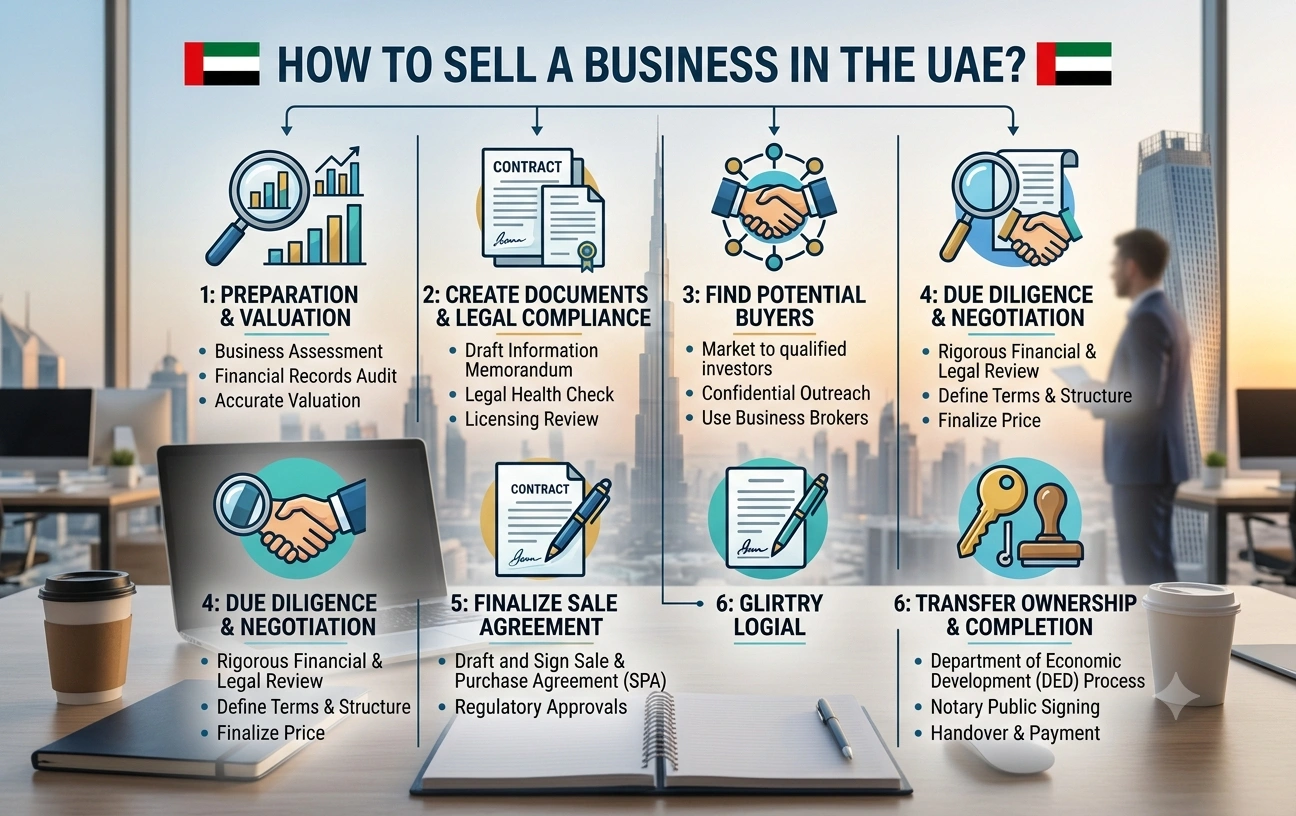
Step-by-Step: How to Sell Your Business in the UAE
Step 1 — Decide Whether Selling Is Actually the Right Move
Every serious buyer will ask why you’re selling, and they need to be comfortable with your answer. Before going further, work through a few honest questions:
- Do you want to fully exit, or keep a stake and stay involved part-time?
- Do you want to sell the whole business, a specific part of it, or split it between multiple buyers?
- How will a sale affect co-shareholders, key staff, customers and suppliers — and are there restrictions in your constitutive documents that limit who you can sell to?
- What will you actually do after the sale? This isn’t a formality — owners who skip this step often struggle post-completion.
Almost any business can be sold if it’s valued realistically and marketed properly — even one that isn’t performing well. The real question isn’t “can I sell,” it’s whether the business is currently in a state that makes it worth buying.
Step 2 — Time the Sale Well
Price is heavily influenced by timing. The strongest position is selling when the business is performing well and you aren’t under pressure to move quickly. Because a full sale process can take anywhere from three to nine months, and buyers want to see two to three years of consistent performance, most advisors recommend starting preparation three to four years before your target exit date — not three to four months.
Step 3 — Make the Business Buyer-Ready (Including 2026 Compliance Items)
This is where most deals gain or lose value. Buyers in 2026 are checking further into a company’s compliance history than they were even a year ago. Before going to market, work through:
- Three to five years of clean, consistent financial statements, cash flows and tax returns.
- Corporate Tax registration and filing status — the FTA moved from educational outreach to automated administrative penalties in late February 2026, so gaps here are now actively flagged. If registration was late, filing the first return within seven months of the end of the tax period can still waive the AED 10,000 late-registration penalty.
- VAT records — a five-year statute of limitations on refund claims and corrections applies from 1 January 2026, so historical VAT filings need to be in order before a buyer’s due diligence team looks at them.
- E-invoicing readiness — if annual revenue is AED 50 million or more, an Accredited Service Provider must be appointed by 31 July 2026 ahead of the national e-invoicing rollout; missing it risks a AED 5,000-per-month fine and is an easy red flag for a buyer’s finance team.
- Emiratization compliance — companies with 50+ employees need 10% Emirati representation in skilled roles, and companies with 20–49 employees in 14 specified sectors must now employ at least two UAE nationals by the end of 2026. Non-compliance penalties run to AED 108,000 per missing hire.
- ESG/greenhouse-gas reporting, if applicable — mandatory GHG reporting has a universal compliance deadline of 30 May 2026 under Federal Decree-Law No. 11 of 2024, with records required to be kept for at least five years.
- A complete, organised data room: trade licence, Memorandum of Association and amendments, UBO filings, shareholder resolutions, key commercial contracts, property leases, IP registrations, employment records, and any litigation or dispute files.
Buyers are unlikely to pay full price for a business that still needs “housekeeping” once due diligence starts — fix these issues before you go to market, not during.
Step 4 — Get a Professional Valuation
Have the business valued before you set an asking price. Overpricing based on emotional attachment, rather than what the market will actually pay, is one of the most common reasons UAE business sales fail. Common valuation methods include:
- Discounted cash flow (DCF) — forecasting future free cash flow and discounting it to today’s value.
- Multiple of earnings (most common) — applying an EBITDA multiple benchmarked against comparable UAE transactions.
- Asset-based valuation — aggregating the value of the business’s assets, on a going-concern or liquidation basis.
- Market comparables — pricing the business against similar companies that have recently sold.
A registered valuator or accountant should lead this exercise — it also surfaces the specific issues you should fix before marketing the business, not just a headline number.
Step 5 — Choose Share Sale or Asset Sale
Shareholders of a limited liability company generally have two routes: sell the shares directly, or have the company sell its underlying assets and goodwill. In a share sale, proceeds go to the shareholders and the buyer inherits the company as-is, including its liabilities. In an asset sale, proceeds go to the company itself, and the buyer can select which assets, contracts and liabilities to take on. Keep an open mind here and discuss structure with a corporate lawyer and the buyer early — it materially changes tax treatment, liability exposure, and how employees and contracts transfer.
Step 6 — Protect Confidentiality and Find a Buyer
A sale process can unsettle staff, customers and suppliers, so most owners keep it confidential until a deal is close to signed. In practice, that means:
- A short, anonymised teaser or blind profile to generate interest without revealing the company’s identity.
- A non-disclosure agreement (NDA) signed before any sensitive financial or commercial information is shared.
- Optionally, a business broker to manage outreach and screen buyers — brokers typically charge 5% to 10% of the deal value, depending on the size and complexity of the transaction and the sector involved.
Step 7 — Negotiate the Letter of Intent (LOI/MOU)
Once you have a serious offer, the next document is usually a Letter of Intent, Heads of Terms, or Memorandum of Understanding — a non-binding outline of price, structure and key conditions (aside from confidentiality and exclusivity clauses, which are typically binding). This document is later superseded by the full Share Purchase Agreement, but it sets the framework everything else is negotiated against.
Step 8 — Due Diligence
This is the buyer’s “check under the hood” phase — a detailed review of the commercial, legal, operational and financial aspects of the business to confirm the information behind their offer is accurate. Depending on the size and complexity of the business, this can take anywhere from a few days to several weeks. A well-organised data room from Step 3 significantly shortens this phase.
Step 9 — Sign the Share Purchase Agreement (SPA)
The SPA is the binding document covering what’s being sold, the price, conditions to completion, warranties, and completion mechanics. It’s usually the buyer’s lawyer who drafts the first version, so you’ll want your own corporate lawyer reviewing it closely. Warranties are statements you make about the business; if one turns out to be untrue, it can expose you to a claim after closing. A disclosure letter — prepared by you, listing exceptions to those warranties — is what limits that exposure, so it deserves as much attention as the SPA itself.
Step 10 — Complete the Legal Transfer of Ownership
This is where the UAE process differs sharply from other jurisdictions, and it depends on where the company is registered.
Mainland companies: Transfer requires initial approval from the Department of Economy and Tourism (DET/DED), followed by notarising the Share Transfer Agreement and amended Memorandum of Association before a UAE Notary Public, then registering the transfer to receive an updated trade licence. This typically takes two to four weeks once documents are in order.
Free zone companies: Each free zone authority acts as its own registrar, and many do not require a public notary, which usually shortens the process to one to three weeks.
Federal licence sale/merger route: For companies (including foreign company branches) registered with the Ministry of Economy & Tourism, the specific “Licence Sale and Merger of Companies” service carries an official government fee of AED 7,500, plus a refundable bank guarantee of AED 50,000 per branch. Required documents include a resolution from the management body of both companies, a merger/sale certificate from the relevant authority, an updated agency contract (or its termination), authorisation for the new manager and their passport copy, and the branch’s registration certificate. The process also requires a public announcement published once in a local Arabic-language newspaper, with a two-week waiting period before the application can be finalised — after which the average service delivery time is around three working days.
Step 11 — Sort Out Employees, Bank Accounts and Contracts
In a share sale, employment contracts, bank accounts and licenses generally stay in place — the company itself hasn’t changed, only its ownership. Banks will still require full KYC on the new shareholders and may restrict account operations until it’s complete; some banks prefer to close and reopen the account under new ownership entirely. Key contracts, particularly office leases, may require landlord consent for a change of control. In an asset sale, by contrast, contracts and employment relationships typically need to be actively renegotiated or terminated and reissued, since the legal entity employing staff and holding those contracts hasn’t transferred.
Step 12 — Get Indemnified and Close Out
Once the sale completes, make sure you’re indemnified against risks or legal claims arising from how the business operated while you owned it. This is standard practice and typically drafted into the SPA — but it’s worth confirming explicitly before signing, so you can walk away from the business with a genuinely clean break.
How Much Does It Cost to Sell a Business in the UAE?
Costs vary by deal size, emirate, and whether the company is mainland or free zone, but the components are consistent:
| Cost item | Typical range / figure | Notes |
|---|---|---|
| Government licence sale/merger fee | AED 7,500 | Ministry of Economy & Tourism federal service fee for the licence sale/merger process. |
| Bank guarantee | AED 50,000 per branch | Refundable; required as part of the federal licence sale/merger process. |
| Notarisation | Varies by emirate and document volume | Applies to mainland Share Transfer Agreements and amended MOAs. |
| DED / free zone authority transfer fees | Varies by authority | Separate from the federal MOE fee; charged by the specific mainland or free zone registrar. |
| Legal fees | Deal-dependent | Covers SPA drafting/review, due diligence support, and disclosure letter preparation. |
| Valuation & accounting fees | Deal-dependent | Registered valuator and/or accountant fees for the valuation exercise and financial clean-up. |
| Business broker fee (optional) | 5%–10% of deal value | Charged only if you engage a broker to manage buyer search and negotiation. |
UAE Business Valuation Benchmarks: What Multiple Should You Expect?
Multiple-of-EBITDA is the most commonly used valuation method for privately held UAE businesses. As a general guide:
| Business profile | Typical EBITDA multiple | Why |
|---|---|---|
| High owner-dependency, limited systems or documented processes | 2x – 4x | Buyers discount for transition risk — the business may struggle without you specifically running it. |
| Strong systems, recurring revenue, business runs independently of the owner | 4x – 6x | Lower transition risk and more predictable future cash flow command a premium. |
| Sectors currently in high demand (real estate, hospitality, e-commerce, tech-enabled SMEs) | Often at the higher end of range, or above with strong growth evidence | Buyer demand is currently concentrated here on the back of D33 momentum, infrastructure spend and UAE e-commerce growth (the sector was valued at roughly AED 45.1 billion / USD 12.3 billion in early 2026). |
These ranges are indicative only — clean, audited financials, a diversified customer base, long-term contracts and a strong compliance record all move the multiple, and only a proper valuation exercise will give you a defensible number to negotiate from.
Realistic Timeline: How Long Does It Take to Sell a UAE Business?
| Phase | Typical duration |
|---|---|
| Preparation (financials, compliance, data room) | 1 – 3 months |
| Buyer search & marketing | 2 – 6 months |
| Negotiation & due diligence | 1 – 3 months |
| Regulatory closing (legal transfer of ownership) | 2 – 6 weeks |
| Total, decision to completed transfer | 3 – 9 months (well-prepared SME deals often close in 4–6 months) |
Tax Treatment of Selling a Business in the UAE (2026)
- There is no personal capital gains tax for individual sellers in the UAE.
- Corporate sellers may be subject to UAE Corporate Tax at 9% on profits above AED 375,000.
- A participation exemption under Article 23 of the Corporate Tax law may exempt capital gains from selling shares in a subsidiary, generally where the seller has held at least 5% of the shares for at least 12 months — conditions apply, and this should be confirmed with a tax advisor before signing.
- Share sales are generally outside the scope of VAT; asset sales may attract VAT depending on exactly what’s being transferred, though transfer-of-a-going-concern relief can apply in some structures.
- From 1 January 2026, a five-year statute of limitations applies to VAT refund claims and corrections — get historical VAT filings in order well before a buyer’s due diligence team asks for them.
Tax treatment depends heavily on your specific structure, so this section is a starting point for a conversation with an FTA-registered tax agent, not a substitute for one.
2026 Regulatory Changes Buyers Are Now Checking Before They Sign
These are new for 2026, and increasingly show up as due-diligence questions — get ahead of them rather than explaining gaps mid-negotiation.
| Change | Key date | Why it matters to a sale |
|---|---|---|
| National e-invoicing rollout | Pilot from 1 July 2026; ASP appointment due 31 July 2026 for businesses ≥AED 50M revenue | Buyers’ finance teams now check e-invoicing/ERP readiness as part of financial due diligence. |
| Expanded Emiratization targets | Compliance required by end of 2026 | 20–49 employee companies in 14 specified sectors must now employ at least two UAE nationals; non-compliance carries penalties of AED 108,000 per missing hire. |
| Mandatory ESG / GHG reporting | Universal compliance deadline 30 May 2026 | Under Federal Decree-Law No. 11 of 2024; records must be kept for at least five years and are increasingly requested in diligence. |
| Corporate Tax enforcement shift | Automated penalties from 27 Feb 2026; Revised Administrative Penalty Framework from 14 Apr 2026 | The FTA has moved from outreach to automated enforcement — unresolved filing gaps are now actively flagged rather than quietly missed. |
| VAT statute of limitations | From 1 Jan 2026 | A firm five-year window applies to VAT refund claims and corrections — old, unresolved VAT positions become harder to fix the longer they’re left. |
Share Sale vs Asset Sale: Which Is Right for You?
| Factor | Share sale | Asset sale |
|---|---|---|
| Who receives the proceeds | Shareholders | The company itself |
| Liabilities | Buyer generally inherits existing liabilities | Buyer can select which liabilities to assume |
| Contracts & employees | Generally continue as-is; banks still require KYC on new shareholders | Typically require renegotiation, transfer or termination and reissue |
| Best suited for | Clean, well-documented businesses where continuity matters to the buyer | Buyers who want specific assets/operations without inheriting the full corporate history |
Common Reasons UAE Business Sales Fall Through
- Unrealistic price expectations that don’t reflect what the market will actually pay — get an independent valuation before you set an asking price, not after a buyer walks.
- Incomplete or disorganised financial and compliance records that slow down or derail due diligence.
- Undisclosed liabilities surfacing during due diligence, which erodes buyer trust even when the issue itself is manageable.
- Slow KYC clearance for foreign buyers, particularly foreign corporate buyers with more complex resolution requirements.
- Missing regulatory approvals that should have been secured before going to market.
- A business that is too dependent on the owner personally, which increases perceived transition risk and pulls the valuation multiple down.
Frequently Asked Questions
How long does it take to sell a business in the UAE?
Most sales take three to nine months from the decision to sell through to a completed transfer. Preparation typically takes one to three months, finding a buyer two to six months, negotiation and due diligence one to three months, and the regulatory closing two to six weeks. Well-prepared SME deals with clean records often complete faster, in the four-to-six-month range.
Do I pay capital gains tax when I sell my business in the UAE?
Individual sellers don’t pay personal capital gains tax. Corporate sellers may owe 9% Corporate Tax on profits above AED 375,000, though a participation exemption can apply to gains from selling shares in a subsidiary if the seller has held at least 5% of the shares for at least 12 months. Confirm your specific position with a tax advisor.
How much does a business broker charge in the UAE?
Business brokers typically charge between 5% and 10% of the final deal value, depending on the size, sector and complexity of the transaction. Using one isn’t mandatory, but it can meaningfully speed up buyer search and screening.
Should I sell shares or assets?
It depends on your goals and the buyer’s preference. A share sale transfers the whole company, including its liabilities, with proceeds going to shareholders. An asset sale lets the buyer select specific assets and liabilities, with proceeds going to the company. Discuss both with a corporate lawyer before deciding.
What happens to my employees when the business is sold?
In a share sale, employment contracts and visas generally remain in place, and the buyer takes on responsibility for the workforce, with any end-of-service liabilities documented in the SPA. In an asset sale, contracts typically need to be actively renegotiated, terminated or reissued.
Can a non-UAE resident or foreign company buy a UAE business?
Yes. Non-residents can acquire shares in UAE companies, though the process involves additional KYC requirements at both the authority level (free zone or DED) and the bank. Foreign corporate buyers add further complexity through corporate resolution requirements, which can extend the closing timeline.
What is the government fee to transfer or sell a business licence in the UAE?
For the Ministry of Economy & Tourism’s federal Licence Sale and Merger of Companies service, the fee is AED 7,500, plus a refundable bank guarantee of AED 50,000 per branch. Separate transfer fees also apply at the DED or free zone authority level, depending on where the company is registered.
What documents do I need to prepare to sell my business?
Core documents include several years of financial statements, the current trade licence, the Memorandum of Association and all amendments, shareholder resolutions, UBO filings, key commercial contracts, employee and visa records, VAT registration and returns, and any sector-specific permits. Building this into an organised data room before buyer due diligence begins saves significant time later.
Do I need a lawyer to sell my business in the UAE?
Yes. A corporate lawyer guides you through the sale process, the due diligence phase, drafting and reviewing the Share Purchase Agreement, and the disclosure phase. You’ll also want a financial advisor or accountant to prepare and present your financial information. Choosing advisors with genuine corporate M&A experience — not general practice — materially affects the outcome.
What is a Letter of Intent (LOI) or Memorandum of Understanding (MOU)?
It’s a document that sets out the fundamental terms of a deal — proposed structure, price and key conditions — agreed early in the process. It’s generally non-binding except for confidentiality and exclusivity clauses, and is later superseded by the full Share Purchase Agreement.
Is my business still sellable if it isn’t very profitable?
Yes, provided it’s valued appropriately and marketed to the right buyers — sometimes financial distress even motivates a buyer who sees a turnaround opportunity. The harder obstacle isn’t low profitability itself, it’s an owner unwilling to price the business realistically for its current condition.
What’s genuinely new for business sellers in the UAE in 2026?
Four things now show up regularly in buyer due diligence: the national e-invoicing rollout (mandatory for large businesses from mid-2026), expanded Emiratization requirements for companies with 20–49 employees in 14 sectors, mandatory ESG/GHG reporting from 30 May 2026, and automated Corporate Tax penalty enforcement by the FTA since late February 2026. Addressing these before going to market avoids them becoming negotiation leverage for the buyer.
Final Thoughts
Selling a business in the UAE in 2026 rewards owners who prepare early: clean financials, a properly organised data room, a realistic valuation, and 2026-specific compliance items handled before a buyer asks about them. The market backdrop is favourable, but the regulatory bar has moved up — the sellers getting the strongest multiples right now are the ones treating compliance readiness as part of the sale process, not an afterthought to it.
This guide is intended as general information and does not constitute legal, tax or financial advice. Every sale is shaped by the specific structure of your business, its emirate and free zone or mainland status, and your personal circumstances — speak with a licensed UAE corporate lawyer, a registered valuator, and an FTA-registered tax agent before acting on any of it.


