

Get Response within 60 Seconds.
Share a few details and get an instant response — one of our setup advisors will follow up with your personalized breakdown right away
If you searched “UAE vs Qatar business setup,” you have probably found a dozen articles that all say the same thing: UAE is faster and Qatar is cheaper. That was true in 2022. It is an incomplete answer in 2026.
Three things changed the calculation this year. First, UAE corporate tax has matured into its second filing cycle, and the 0% free-zone rate is now far narrower than most guides describe. Second, Qatar’s foreign-ownership and setup-speed reforms have closed much of the old ownership and process gap with the UAE. Third — and this is the part most comparison articles simply do not mention — a regional conflict that began in February 2026 has hit Qatar’s economy directly and reshaped the risk calculus for anyone weighing the two jurisdictions.
This guide walks through all of it: tax, cost, timelines, ownership rules, visas, and the current economic and security picture, with every figure sourced to a primary regulator, the IMF, or a dated 2026 report.
Quick Answer: UAE vs Qatar at a Glance
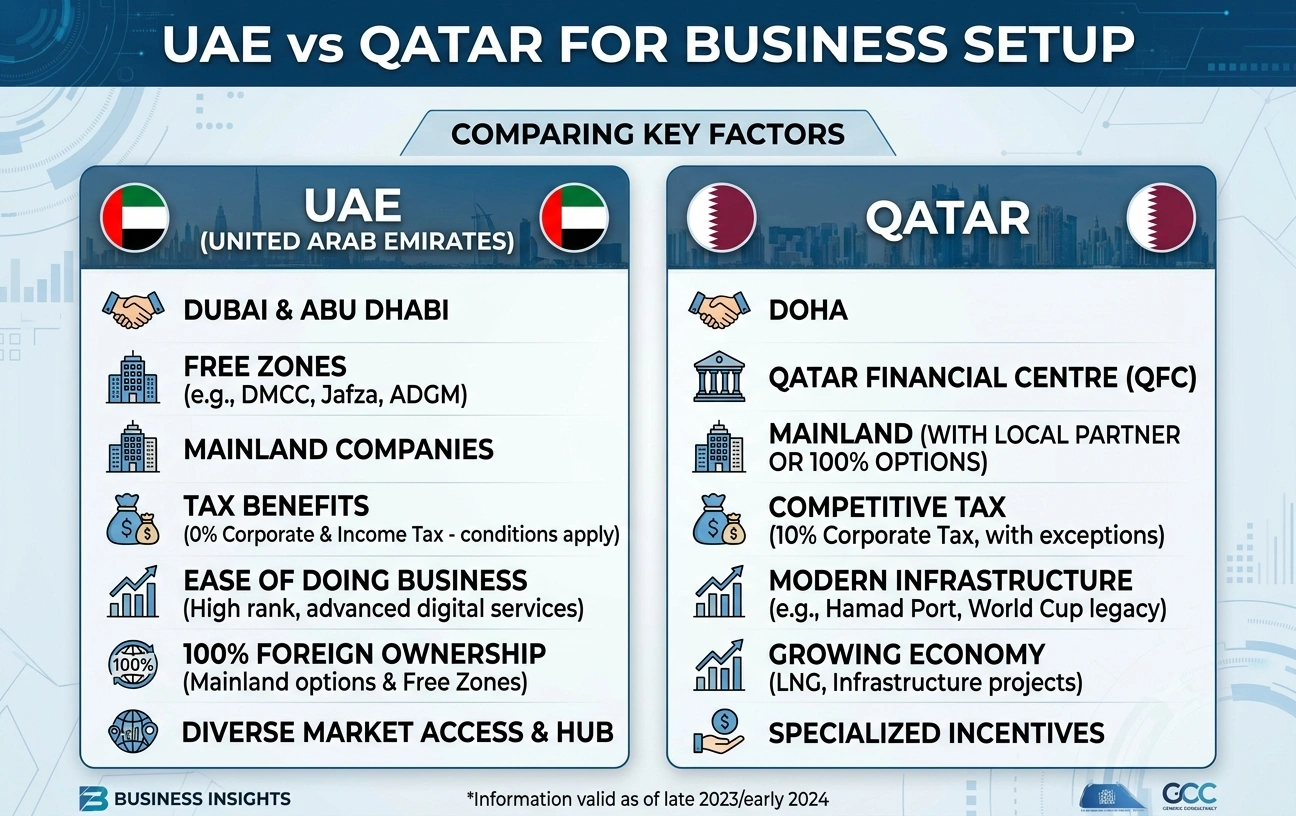
| Factor | UAE | Qatar |
|---|---|---|
| Standard corporate tax | 9% on profit above AED 375,000 | 10% on the foreign-owned share of profit |
| Free zone / 0% rate | 0% only for Qualifying Free Zone Persons on “qualifying income” — strict annual test | 0% or reduced rates for qualifying QFZA/QFC activities |
| VAT | 5% (in force since 2018) | Not yet implemented as of Sept 2026 (5% planned, no confirmed date) |
| Personal income tax | 0% | 0% |
| 100% foreign ownership | Yes — most mainland activities (since 2021) and all free zones | Yes in most sectors since 2019 reform; some mainland activities still need a Qatari partner |
| Free zone setup timeline | License in 3–5 days; 4–8 weeks to a working bank account | 2–6 weeks (QFZA / QFC) |
| Mainland setup timeline | 3–6 weeks | 7–15 working days for simple cases; up to 8–16 weeks for complex ones |
| Entry-level Year-1 setup cost | ~AED 11,000–20,000 (budget free zones) | ~QAR 15,000–50,000 (mainland WLL, all-in) |
| Residency by investment | AED 2,000,000 real estate → 10-year renewable Golden Visa | $200,000 real estate → renewable temporary residency; $1,000,000 → permanent (annual quota) |
| Population / talent pool | ~11.6 million | ~3.2 million |
| 2026 GDP growth (IMF, post-conflict) | +3.1% (revised down 1.9 points) | −8.6% contraction (revised down 14.7 points) |
| Best suited for | SaaS, e-commerce, trading, fintech, professional services at volume | Energy/LNG, sovereign and infrastructure deal flow, low-competition advisory |
Sources: UAE Federal Tax Authority / Federal Decree-Law 47 of 2022; Qatar General Tax Authority and Ministry of Commerce and Industry; IMF World Economic Outlook, April 2026; UAE ICP Golden Visa portal; Qatar residency-by-investment framework (Cabinet Resolution No. 28 of 2020). Figures current as of September 2026 — see the freshness note near the end of this guide.
The 2026 Context Most Comparisons Miss: The Gulf Conflict
No honest UAE-vs-Qatar comparison written after February 2026 can skip this, and it is the single biggest reason older articles are now out of date.
On February 28, 2026, US and Israeli strikes on Iran triggered a regional conflict that, within 48 hours, saw Iran retaliate against all six Gulf Cooperation Council states. Qatar — home to the world’s largest LNG export terminal at Ras Laffan and the United States’ largest regional military base — absorbed some of the most direct impact. Strikes on the Ras Laffan complex knocked out an estimated 17% of Qatar’s LNG export capacity for an expected three to five years, with QatarEnergy estimating roughly $20 billion a year in lost revenue. Qatar briefly closed its airspace and halted LNG production entirely in early March.
Iran’s intermittent blockade of the Strait of Hormuz — the waterway that carries roughly a fifth of the world’s LNG and a quarter of its seaborne oil — has been the central economic flashpoint. A US-Iran ceasefire announced on April 7–8 repeatedly broke down through the spring and summer; a further memorandum signed in June 2026 collapsed in July when shipping in the strait was targeted again. A new 60-day ceasefire took hold around July 2026, and by late August, Qatar’s prime minister was in Tehran discussing a temporary shipping corridor and a joint mine-clearing effort with Iran’s foreign minister. As of this writing, the situation is fragile but has stabilized somewhat since the spring.
The economic damage shows up clearly in the IMF’s April 2026 World Economic Outlook, released mid-conflict: Qatar’s 2026 growth forecast was cut by 14.7 percentage points to a projected 8.6% contraction — among the sharpest downgrades in the world. The UAE’s forecast was also cut, but far less severely: down 1.9 points to a still-positive 3.1% growth. S&P Global’s independent estimate puts Qatar’s contraction closer to 5%, and Oxford Economics has flagged that the North Field LNG expansion — Qatar’s flagship growth project, meant to lift capacity from 77 to 142 million tonnes a year by 2030 — now faces a revised timeline.
What this means practically for a founder comparing the two countries:
- UAE’s exposure has been comparatively contained. It has a partial pipeline bypass route for crude (Abu Dhabi–Fujairah), a diversified non-oil economy, and its growth forecast, while trimmed, remains positive.
- Qatar’s exposure is structural, not incidental: LNG can only leave the country via Ras Laffan and the Strait, and there is no alternative export route. That is the core vulnerability behind the sharper downgrade.
- Qatar is not without countervailing strength. The Qatar Investment Authority manages upwards of $500 billion in assets, the government has rolled out economic support packages, and Doha’s mediating role in the ceasefire talks has arguably raised its diplomatic standing.
- For businesses tied to energy, reconstruction, logistics, or government-adjacent contracts, the disruption is also creating real near-term demand — repair and rebuild spending at Ras Laffan alone is estimated in the tens of billions of dollars.
If your business model depends on Qatar-based supply chains, LNG-adjacent trade, or physical presence near the Gulf, treat this as a live risk factor to monitor — not a one-off news event. Check the latest guidance from your national travel advisory and Qatar’s Ministry of Foreign Affairs before committing to a Doha-based structure, and build shipping and insurance contingencies into any Gulf-dependent logistics plan.
Corporate Tax and VAT: What Actually Applies in 2026
UAE
The UAE’s federal corporate tax (Federal Decree-Law No. 47 of 2022) charges 9% on annual profit above AED 375,000. Free zone companies are not automatically tax-free — this is the most common misconception in UAE structuring. Only a company that qualifies as a “Qualifying Free Zone Person” (QFZP) gets the 0% rate, and only on its “qualifying income.” To hold that status a company must maintain real economic substance in the UAE (staff, premises, and spend appropriate to the business — a virtual flexi-desk alone does not count), earn income that falls within the activities defined by Ministerial Decision No. 229 of 2025, and keep non-qualifying revenue under the lower of AED 5 million or 5% of total revenue. Breach any condition and the company loses QFZP status for that tax period plus the following four — taxed at the full 9% on everything, with a retest only in year six.
VAT sits separately at 5% and has applied since 2018. A Domestic Minimum Top-up Tax of 15% now also applies to large multinational groups (global revenue above roughly €750 million) in line with the OECD’s global minimum tax framework, effective from January 2025. Companies with a calendar-year financial year are filing their second corporate tax return cycle by 30 September 2026, with the Federal Tax Authority applying noticeably tighter scrutiny to qualifying-income claims than in cycle one.
Qatar
Qatar’s standard corporate income tax is 10%, but it is only charged on the share of profit attributable to non-Qatari, non-GCC ownership — a wholly Qatari- or GCC-owned company pays none. Hydrocarbon and petrochemical operations are taxed separately, with a minimum rate of 35% under their production-sharing contracts. The Qatar Financial Centre and Qatar Free Zones Authority both offer 0% or reduced rates for qualifying activities, though the exact terms depend on your sector and should be confirmed with the regulator directly rather than assumed.
The headline 2026 story is VAT: despite years of GCC-framework commitments and a draft e-invoicing law approved on 6 May 2026 (widely read as groundwork for VAT), Qatar has still not implemented VAT as of September 2026. No official date has been set. Kuwait is now the only other GCC state without VAT. Qatar has also rolled out a Domestic Minimum Top-up Tax aligned with the OECD’s Pillar Two rules and, earlier in 2026, introduced a capital-gains relief for corporate restructurings and a mechanism to apply tax-treaty relief directly at source — both aimed at making the jurisdiction more attractive to holding structures.
Neither country taxes personal income. Treat the qualifying-income and QFZP rules in the UAE, and the VAT-implementation date in Qatar, as the two figures in this table most likely to change — confirm both before finalizing any structure.
Company Setup: Cost and Timeline Compared
Both countries have narrowed the old “UAE fast, Qatar slow” gap considerably. The honest picture in 2026 is that UAE free zones remain the fastest route to a functioning company, but Qatar’s free zones and QFC are now competitive, and Qatar’s mainland registration can be quicker than commonly assumed for straightforward activities.
UAE
| Structure | Year-1 all-in cost | License issuance | Time to fully operational |
|---|---|---|---|
| Budget free zone (SHAMS, IFZA, Ajman FZ, UAQ FTZ) | AED 11,000 – 20,000 | 3–5 business days | 4–8 weeks incl. banking |
| Premium free zone (DMCC, DIFC, JAFZA, ADGM) | AED 30,000 – 50,000+ | 3–5 business days | 4–8 weeks incl. banking |
| Mainland LLC (DED / DET) | AED 35,000 – 75,000 | 1–2 weeks | 3–6 weeks |
Qatar
| Structure | Year-1 all-in cost | Registration | Time to fully operational |
|---|---|---|---|
| Mainland WLL (MOCI) | QAR 15,000 – 50,000 (+ QAR 50,000 min. capital) | 7–15 working days, simple cases | Up to 8–16 weeks for complex structures |
| Qatar Free Zone (QFZA — Ras Bufontas / Umm Alhoul) | From QAR 20,000/yr licence | — | 2–4 weeks |
| Qatar Financial Centre (QFC) | QAR 5,000 application + QAR 10,000–30,000/yr | — | 2–6 weeks |
Qatar’s government-backed Invest Qatar program can cover up to 40% of eligible setup costs for qualifying businesses — worth checking before budgeting, since it materially changes the cost comparison for sectors Qatar is actively courting (technology, logistics, sports and events, education).
Free Zones: Breadth vs. Focus
The UAE’s advantage here is sheer optionality: more than 40 free zones, each positioned for a different activity — DMCC and JAFZA for trading and logistics, DIFC and ADGM for financial services under English common law, Dubai Internet City and Dubai South for tech, dozens of lower-cost zones (IFZA, SHAMS, RAKEZ, Ajman) for cost-sensitive service businesses. That density also means the surrounding ecosystem — lawyers, auditors, fund administrators, recruiters — is deep and walkable.
Qatar runs a narrower, more deliberately targeted model: the Qatar Financial Centre for financial and professional services under its own common-law framework, the Qatar Free Zones Authority (covering Ras Bufontas near the airport and Umm Alhoul near the port) for logistics, manufacturing, technology and aviation, and the Qatar Science & Technology Park for R&D-driven ventures. Fewer options, but also far less competition per zone — coworking-market research puts the ratio of professional-services firms per capita at roughly a fifth of the UAE’s, which several Doha-based advisors cite as a genuine advantage for firms trying to get noticed.
Foreign Ownership Rules
Until 2021, most UAE mainland companies required a UAE national to hold at least 51%. The Commercial Companies Law amendments that year opened the large majority of mainland activities to 100% foreign ownership, removing the local-sponsor requirement outright for those activities (some strategic and security-sensitive sectors remain restricted). All UAE free zone companies have always permitted 100% foreign ownership.
Qatar moved on the same theme two years earlier: its 2019 Foreign Investment Law opened most sectors to up to 100% foreign ownership in mainland WLL companies, a significant change from the traditional 51%-Qatari-partner structure. Some sectors remain restricted or require the local-partner model, so activity-by-activity confirmation still matters more in Qatar than in the UAE. Free zone and QFC entities in Qatar have no local-sponsor requirement at all, matching the UAE’s free zone model.
Residency and “Golden Visa” Routes
The UAE’s real-estate Golden Visa route requires property valued at AED 2,000,000 or more (title-deed purchase price, not current market value), and grants a renewable 10-year residence permit with full family sponsorship and no minimum-stay requirement. 2026 reforms made mortgaged and off-plan property easier to qualify — investors can now count paid-in equity toward the threshold and combine multiple properties to reach it. Separate routes exist for entrepreneurs (AED 1,000,000 in SME revenue, or an innovative project valued from AED 500,000) and skilled professionals (a basic monthly salary from AED 30,000 plus a recognized degree). Dubai alone issued over 100,000 real-estate-investor family visas between 2021 and early 2026.
Qatar has not branded its equivalent a “Golden Visa,” but the structure is comparable: a property investment of QAR 730,000 (about $200,000) in a designated freehold zone — The Pearl, Lusail, West Bay Lagoon, and similar areas — secures a renewable residence permit, subject to a 90-day-per-year minimum stay. A QAR 3,650,000 (about $1,000,000) investment unlocks permanent residency, with benefits including free access to public healthcare and education — though this tier is capped at a limited annual quota, so timing matters more than in the UAE’s uncapped program.
Economy Snapshot: Two Very Different Bets
The UAE runs a population of roughly 11.6 million against a 2026 nominal GDP near $621.5 billion and GDP per capita around $54,200, built on a genuinely diversified base — trade, tourism, finance, logistics, and technology alongside oil. Qatar’s population is much smaller, around 3.2 million, but its GDP per capita is consistently among the highest in the world, underpinned overwhelmingly by natural gas: the North Field / South Pars field it shares with Iran supplies roughly 80% of Qatari government revenue.
That concentration is precisely what has made 2026 a harder year for Qatar than for the UAE. It is also why the two economies attract structurally different capital: the UAE draws broad-based private-sector investment across sectors and geographies, while Qatar’s capital flows are more concentrated around sovereign wealth (the Qatar Investment Authority), energy majors, and government-anchored infrastructure — a pattern that predates 2026 and will likely persist once the current disruption settles.
Which Country Fits Your Business?
Lean UAE if:
- Your customers are broad-based private sector — SaaS, e-commerce, fintech, consulting, general trading — rather than a handful of large institutional buyers.
- You need the deepest possible bench of lawyers, auditors, fund administrators, and recruiters within walking distance.
- Setup speed and free-zone optionality matter more than being close to a specific government counterparty.
- You want the broadest, least-capped path to long-term residency.
Lean Qatar if:
- Your pipeline runs through the Qatar Investment Authority, QatarEnergy, or state-backed mega-projects — including 2026’s LNG-facility reconstruction and the run-up to the 2030 Asian Games.
- You’re in energy, LNG-adjacent engineering, or infrastructure services with existing Gulf relationships.
- Lower competition matters more to you than volume — fewer firms per capita generally means easier visibility with the same effort.
- Your budget is sensitive to office cost: Doha flex-office pricing runs roughly 30% below UAE equivalents for comparable positioning.
A middle path many scale-ups use:
Start in the UAE for execution speed and market breadth, then add a Qatar entity once specific Qatari deal flow — a QIA-adjacent contract, an energy-sector relationship, an infrastructure tender — actually materializes. This “UAE-first, Doha-second” sequencing shows up repeatedly in Gulf-market advisory guidance because it limits exposure to Qatar’s currently elevated macro volatility while keeping the option open.
Banking and Talent, Briefly
UAE corporate banking is the more mature of the two markets, with a wider bench of international and local banks and generally faster account approvals — commonly 2 to 6 weeks from application. Qatar’s QFC-licensed entities get a comparatively streamlined banking process tailored to the centre; companies registered outside the QFC typically face more document-heavy account opening. On talent, the UAE’s much larger expatriate population and broader visa infrastructure give it a materially deeper hiring pool across most disciplines; Qatar’s workforce is smaller and more concentrated in energy, construction, and public-sector-adjacent fields.
Frequently Asked Questions
Is the UAE or Qatar better for business setup in 2026?
There is no single answer — it depends on your sector and client base. The UAE wins on setup speed, free-zone choice, service-provider depth, and macro stability. Qatar wins for businesses whose growth genuinely runs through energy, sovereign wealth, or state-backed infrastructure, and for founders who value lower competition over a bigger overall market. Most private-sector, broad-market businesses default to the UAE; sector-specific and government-adjacent businesses should evaluate Qatar on its own merits rather than dismissing it by default.
Does Qatar charge VAT in 2026?
No. As of September 2026, Qatar has not implemented VAT, despite a 2026 draft e-invoicing law widely seen as preparatory groundwork. A 5% rate is expected once VAT is introduced, in line with the GCC VAT framework, but no official implementation date has been announced.
What is the actual corporate tax rate in each country?
UAE: 9% above AED 375,000 in annual profit, with a 0% rate available only to Qualifying Free Zone Persons on qualifying income. Qatar: 10% on the profit share attributable to foreign ownership, with 0% or reduced rates available for qualifying QFC/QFZA activities. Both apply a Domestic Minimum Top-up Tax of 15% to in-scope large multinational groups under the OECD’s global minimum tax rules.
Can a foreigner own 100% of a company in Qatar?
In most sectors, yes, since the 2019 Foreign Investment Law. Some activities remain restricted or still require a Qatari partner holding at least 51%, so this should be confirmed for your specific activity code before you commit to a structure. Free zone and QFC entities have no local-ownership requirement at all.
How much does it cost to set up a company in the UAE vs Qatar?
Entry-level UAE free zone setups start around AED 11,000–20,000 in year one; entry-level Qatar mainland WLL setups run roughly QAR 15,000–50,000 plus a QAR 50,000 minimum capital requirement. Once visas, office space, and banking are added, realistic all-in first-year budgets typically land in the AED 35,000–75,000 range for a UAE mainland LLC and a broadly comparable QAR range for a Qatari mainland WLL — the two are closer than older comparisons suggest.
Is Qatar safe for business given the 2026 conflict?
Qatar’s government and economy remain functional, and diplomatic efforts — including Qatar’s own mediating role — have de-escalated the acute phase of the conflict since the spring. That said, the underlying Strait of Hormuz dispute is unresolved and has re-escalated more than once in 2026, and Qatar’s LNG export capacity remains structurally exposed. Businesses considering Qatar, particularly in logistics, energy, or anything requiring physical Gulf shipping, should treat this as an active risk to monitor via official government and travel-advisory channels rather than a closed chapter.
Which country has the better residency-by-investment program?
The UAE’s AED 2,000,000 Golden Visa route is uncapped, faster to process, and has no minimum-stay requirement, making it the more flexible option for most investors. Qatar’s route is competitively priced at the entry tier (about $200,000) but its top permanent-residency tier is capped at a limited annual quota and requires 90 days of physical presence a year — better suited to investors planning genuine relocation than to those seeking a flexible add-on residency.


